← the scenic garden Wien · 1960–1971 · Aktionismus
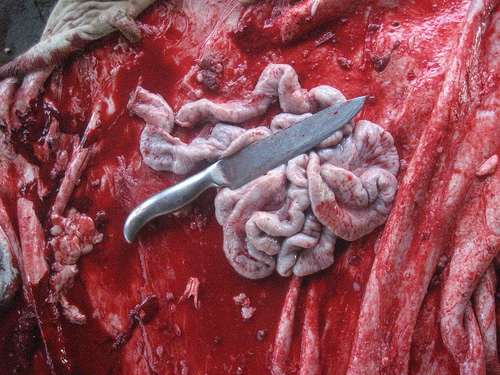
A close, visceral field of blood and animal entrails with a butcher's knife laid across them — the raw slaughterhouse matter of an Actionist ritual.

Photograph by matias jaramillo, Bogotá · Wikimedia Commons CC BY 2.0

Avant & Anti-Art · a cell of four · Vienna

Viennese
Actionism

A violent ritual-body art that used blood, flesh, and transgression to exorcise a repressed postwar Austria.

Place Vienna Era 1960–1971 Morphology cell Mediums the ritual action · performance · the manifesto Archetypes Orpheus · the Trickster

I. Aktion — Das Manifest

Four solitary extremities, converging on the same wound

Viennese Actionism was less a movement than a shared reflex. Four Viennese painters — Nitsch, Brus, Muehl, Schwarzkogler — each discovered, independently and then in mutual contagion, that the canvas could not hold what postwar Austria refused to say aloud.

Between 1960 and 1971 they replaced paint with blood, milk, entrails, urine, and their own bodies, staging Actions that were part Catholic Mass, part slaughterhouse, part psychoanalytic exorcism. The gallery wall gave way to the altar and the operating table at once.

Vienna Actionism never was a group. — Hermann Nitsch

II. Aktion — Die Zelle · the four

A tiny, notorious circle

A small Vienna core, bound together by transgression and Nitsch's ceremonial vision — then dispersed by prosecution, exile, and death into utterly divergent lives.

Aktionist 01

Hermann Nitsch

Architect of the Orgien-Mysterien-Theater — the total, ongoing ritual that outlived the group as its own theatre.

Aktionist 02

Otto Muehl

Pushed the Action toward the collective body; would later found an ill-fated commune.

Aktionist 03

Günter Brus

Turned his own body into the surface pushed to violent extremity — self-painting into open transgression.

Aktionist 04

Rudolf Schwarzkogler

The one whose death, in the early years, was mythologised around the group forever after.
Blood, animal entrails, and a butcher's knife — the base matter of an Actionist ritual, photographed close.
The base matter of the Action — blood, flesh, the blade. Photograph by matias jaramillo, Bogotá. Wikimedia Commons CC BY 2.0

III. Aktion — Die Motive

The recurring wound

01Blood, flesh, and ritual sacrifice
02The body pushed to violent extremity
03Catholic ritual détourned into transgression
04Art as collective exorcism

IV. Aktion — Memetische Kräfte

Why the taboo spread

Confronting a repressed, unreconstructed postwar Austria with visceral taboo felt like a necessary purge — art performing the reckoning a society would not.

The sheer extremity of the actions created intense notoriety and, with it, a bonded, embattled core: the outrage that isolated them also welded them together.

And the ritual framing lent the shock a mythic, cathartic depth — this was never mere provocation, but liturgy turned inside out.

V. Aktion — Das Prinzip

The single conviction

Art should become a total, often violent, quasi-religious ritual acted on the body — releasing repressed drives and confronting a society in denial of its past.

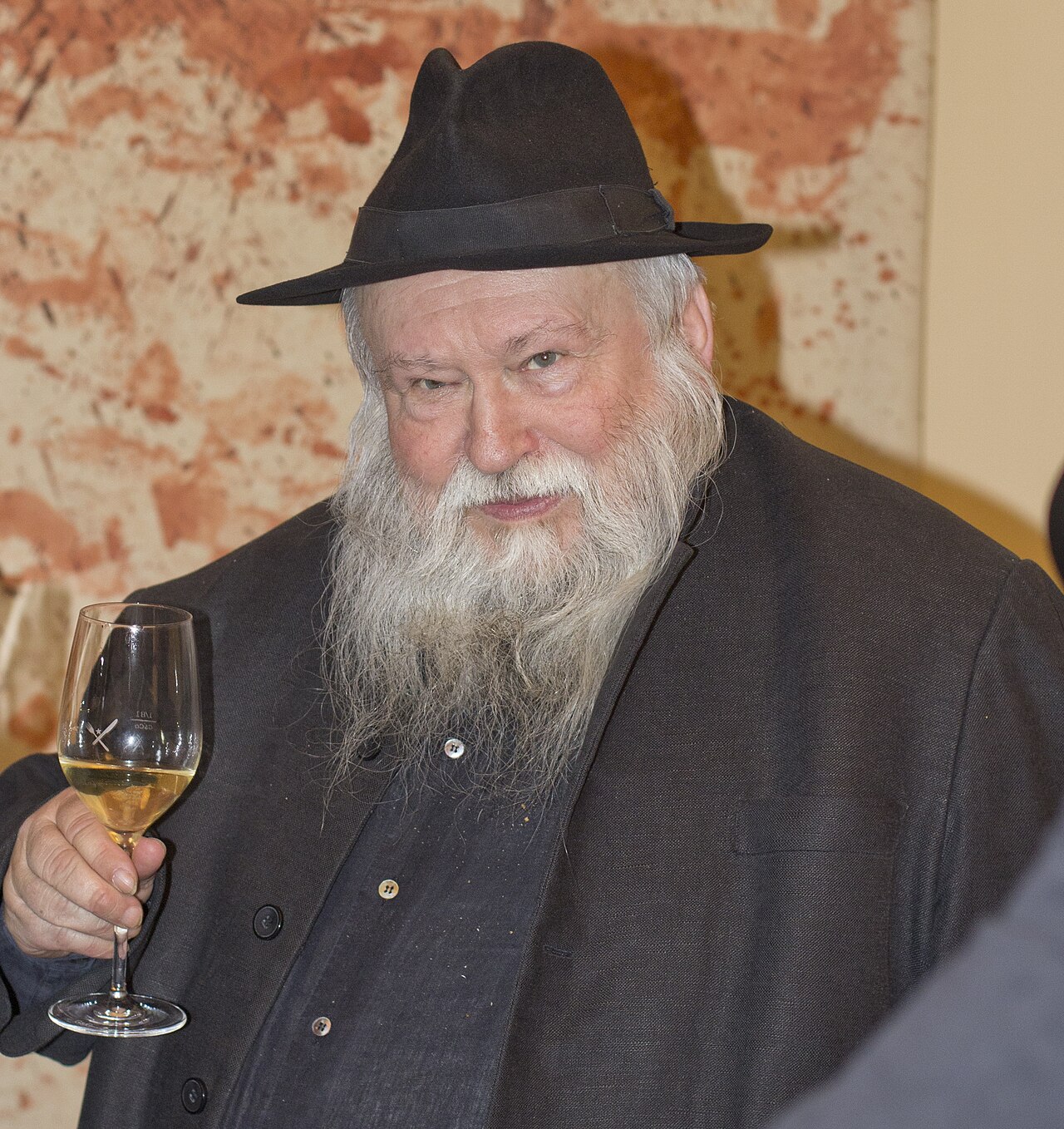
Hermann Nitsch as an old man, in a black hat and dark coat, holding a glass of wine before one of his blood-red splatter paintings.
Hermann Nitsch, 2012 — the priest of the O.M. Theatre in old age, before his own poured red. Photograph by Gerhard »GeWalt« Walter. Wikimedia Commons CC BY-SA 3.0

VI. Aktion — Konvergenz & Divergenz

What bound them · what tore them apart

✚ Convergent engines

  • A small Vienna core — Nitsch, Muehl, Brus, Schwarzkogler
  • The ritual "action" as a shared form
  • Nitsch's Orgien-Mysterien-Theater framework

✕ Divergent engines

  • Prosecution, imprisonment, and exile
  • A death — Schwarzkogler — mythologised around the group
  • Members' divergent later paths: Muehl's commune, Nitsch's theatre

VII. Aktion — Innere Dynamik

Under constant legal threat

A tiny, notorious circle staging escalating bodily rituals under constant legal threat — bound together by transgression and Nitsch's ceremonial vision, escalating precisely because the state was watching.

Hermann Nitsch at night in a pale hat and black clothing, emerging from darkness at a festival in 2010.
Nitsch at Grafenegg, 2010 — the survivor of the cell, half a century on. Photograph by Franz Johann Morgenbesser, Vienna. Wikimedia Commons CC BY-SA 2.0

VIII. Aktion — Gesellschaft

The lasting confrontation

A foundational reference for body art and extreme performance — and a lasting confrontation of Austria with its own repression and its Catholic-authoritarian legacy. The wound they opened did not close when the group did.

Signatur — the scenius signature

A handful of Viennese artists

…turning the body and ritual taboo into a collective exorcism potent enough to define body art itself.

Das Ende — the fate

Dispersed by the early 1970s into individual practices — Nitsch's ongoing theatre, Muehl's ill-fated commune — and canonised, permanently, in the history of performance.