The Brief
A Scene of Synthesists
The Theosophical Society was less a scene of artists or scientists than a scene of synthesists: a small circle of New York Spiritualists, freethinkers, and Egyptologically-minded amateurs who, in the space of a single decade, manufactured an entire alternative cosmology out of borrowed fragments — Neoplatonism, Kabbalah, Hermeticism, Buddhist and Hindu metaphysics, mesmerism, and comparative philology — and gave it institutional legs.
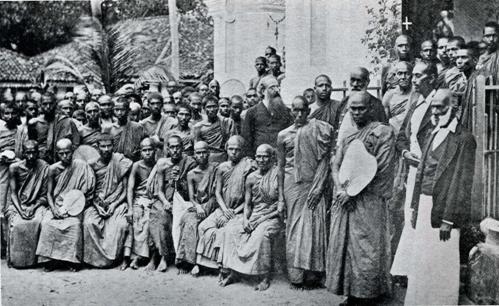
Helena Petrovna Blavatsky supplied the charismatic revelation (claimed communications from Hidden Masters, the ‘Mahatma Letters’ channeled to A. P. Sinnett, the sprawling cosmogony of Isis Unveiled, 1877, and The Secret Doctrine, 1888); Henry Steel Olcott supplied the organizational discipline of a Civil War colonel and lawyer; William Quan Judge supplied continuity in America. What began at the Eddy farm séances in Vermont in 1874 as an extension of Spiritualism was redirected, within a year, toward ‘Occultism, the Cabala, etc.,’ then toward the East, as Blavatsky and Olcott relocated to India in 1878–79, formally converted to Buddhism in Ceylon in 1880, and planted the Society’s permanent headquarters at Adyar, Madras, in 1882.
From a handful of founders it grew into an international lodge system whose Three Objects gave a loose network of local branches a shared creed without a shared discipline, and whose downstream progeny — Anthroposophy, the New Age, esoterically-inflected modern abstraction — vastly outran the parent body itself.
The Founders
Three who built the vessel
Helena Blavatsky
The RevelatorRussian émigré and occultist; conduit of the Hidden Masters and author of the movement’s founding cosmogonies, Isis Unveiled and The Secret Doctrine.
Henry Steel Olcott
The OrganizerCivil War colonel and lawyer; first President, who gave the revelation the discipline of charters, lodges, and a global institution seated at Adyar.
Annie Besant
The SuccessorFreethinker and reformer turned second President; carried the Society into the twentieth century — and into the storm of the Krishnamurti messiah project.
The Unifying Doctrine
One wisdom beneath all religions
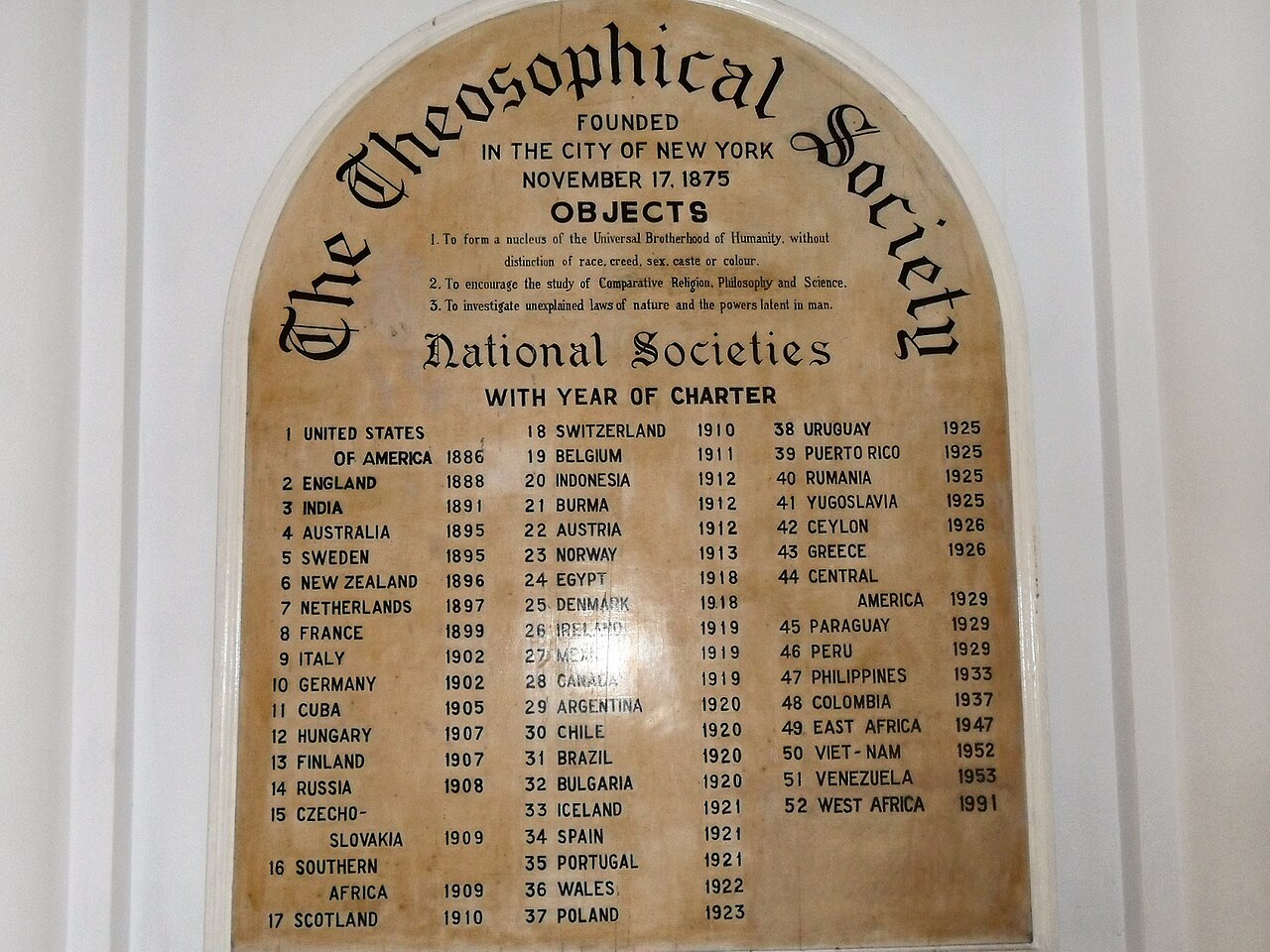
A single ancient wisdom-tradition underlies all religions and science; through spiritual evolution and hidden teachers, humanity ascends — and this esoteric knowledge can be studied and shared. The creed was fixed in three founding Objects, inscribed on every lodge’s charter.
To form a nucleus of the Universal Brotherhood of Humanity, without distinction of race, creed, sex, caste, or colour.
To encourage the comparative study of Religion, Philosophy, and Science.
To investigate the unexplained laws of nature and the powers latent in humanity.
Recurring Motifs
The figures in the carpet
The ancient wisdom uniting all religions.
Hidden Masters and secret doctrine.
Spiritual evolution and root races.
East and West synthesized.
Memetic Forces
Why it spread
- It offered a spiritual-but-scientific worldview to those alienated from orthodox religion by Darwin and materialism.
- Claims of hidden Masters and secret knowledge created an irresistible mystery — and an irresistible hierarchy.
- A global lodge network gave members belonging, and a sense of participating in cosmic history.
The Two Currents
What gathered it, what tore it
Convergent Engines
the ascending triangle — forces that drew the Society together
- Blavatsky’s foundational texts — Isis Unveiled, The Secret Doctrine.
- A global network of lodges.
- Charismatic leadership — Blavatsky, then Besant.
Divergent Engines
the descending triangle — forces that split it apart
- Schisms and rival successor bodies after Blavatsky’s death.
- Scandals over the Masters and the Krishnamurti messiah project.
- Doctrinal offshoots — Anthroposophy, Ariosophy — breaking away.
Internal Dynamics
A society always splitting
A worldwide esoteric society run through lodges and charismatic leaders, perpetually splitting over succession, doctrine, and the authenticity of its hidden Masters.
Society Impact
The composted seedbed
Seeded the entire New Age, brought Eastern concepts — karma, reincarnation — into Western popular culture, and, through its spiritual abstraction, influenced Kandinsky, Mondrian, and the birth of abstract art.
Relics & Records
The material trace


Scenius Signature
A global lodge network and a secret doctrine that synthesized East and West into a template every later esoteric and New Age movement would draw on.
The Fate
How it ended, where it went
Declined as an organization but composted thoroughly into the New Age, alternative spirituality, and — unexpectedly — modernist abstract art.
Mediums & Archetypes
The vessels it worked through
Sources & Credits
Colophon
Prose compressed from public web sources (Wikipedia-led); coded as high-confidence, not yet independently verified. Images are credited below and used under their stated licenses.
- ‘Theosophical Society,’ Wikipedia — founding events, the Three Objects, relocation to Adyar, the post-1891 schisms, and downstream influence.
- ‘Theosophical Society is Founded,’ EBSCO Research Starters (History) — founding context and organizational development.
- ‘Theosophical Society,’ Encyclopedia.com — doctrinal synthesis and cultural legacy.
- ‘Helena Blavatsky,’ Wikipedia — biography, claimed Master contacts, the Mahatma Letters, the 1884 SPR controversy.
- Image — Commemorative plate, Chennai: Milei.vencel, Hungary · CC BY-SA 3.0 · source.
- Image — Olcott and Buddhists, Colombo (1883): Public domain · source.