← the scenic garden
Bureau de recherches surréalistes
15, rue de Grenelle · Paris VII
Ouvert 11 octobre 1924
Registre No. 001
Directeur : A. Artaud
Heures : deux membres, tous les jours
Bureau of Surrealist Research — a storefront laboratory of the unconscious

Surrealist
Research Bureau

PARIS · 1924 – 1966 BIOME · AVANT & ANTI-ART MORPHOLOGY · THE CELL GENERATIVITY · 5 / 5

A movement that mapped the unconscious as a new continent — using automatism and dream to liberate desire and remake life.

§ 01 the case file / le dossier

SUBJECT: The Bureau · OPENED: 11 Oct 1924 · CLOSED: ~Apr 1925 · STATUS: dissolved into the century

Opened on 11 October 1924 at 15 Rue de Grenelle — four days before André Breton published the first Surrealist Manifesto — the Bureau de recherches surréalistes was less an art group's clubhouse than a storefront laboratory of the unconscious. Premises came via Pierre Naville's family; Antonin Artaud served as initial director, with Aragon, Desnos, and Breton rotating through. The office kept regular hours, requiring at least two members present daily to receive visitors, who were invited to "bring their dreams," reports of coincidences, opinions on fashion and politics, and accounts of inventions.

A notebook recorded these encounters, typed up afterward by Simone Breton. In barely six months the Bureau built dual archives — dream imagery and social phenomena — issued circulating leaflets (papillons), ran collective enquêtes on suicide and sexuality, coordinated the launch of La Révolution surréaliste (December 1924), and staged automatic-writing and trance sessions, before closing around April 1925 as internal conflict over artistic versus political direction let Breton consolidate control.

Avis au public · papillon
Bring us your dreams.
15, rue de Grenelle — deposit here
  • The dreams you had last night, and cannot explain
  • Reports of coincidence, of objective chance
  • Your opinions on fashion, on politics, on love
  • Accounts of inventions no one has yet built

§ 02 recurring motifs / registre des motifs

M·i
Automatism — writing & drawing dictated by the unconscious
M·ii
The dream and the marvelous
M·iii
The exquisite corpse and collective play
M·iv
Desire and revolution as a single project
M·v
Objective chance

§ 03 the unifying principle / le principe

The unconscious is the true source of freedom; by dissolving the boundary between dream and waking, art can liberate desire and transform life itself.

§ 04 what kept it burning / forces mémétiques

Three currents made membership feel like a total, life-staked pursuit — an inexhaustible territory anyone could explore in themselves.

Archive A — the pull

  • Freud's unconscious offered an inexhaustible, thrilling new territory anyone could explore inside themselves.
  • Breton's excommunications made membership feel consequential and pure.
  • The fusion of art with erotic and political liberation gave it total life-stakes.

Archive B — the engines

  • Converge: Breton as pope-figure, the Bureau as a literal office; shared games and techniques; a manifesto and a controlled journal.
  • Diverge: Breton's serial excommunications; the fight over Communist allegiance; WWII scattering the group to the Americas.

§ 05 internal dynamics / le pape & les excommuniés

An authoritarian avant-garde: a strong center — Breton — enforcing doctrine by expulsion. The method kept the movement coherent and generative for decades, but bled it steadily of talent. Coherence bought at the cost of its own people.

Struck from the register Antonin Artaud Salvador Dalí Robert Desnos Philippe Soupault Roger Vitrac — & many more

§ 06 its mark on the world / impact

It colonized the 20th-century imagination — advertising, film, and design all run on Surrealist dream-logic — and made the unconscious a shared cultural given.

SCENIUS SIGNATURE — the thing only this scene could do

A disciplined collective method for mining the unconscious — turning private dream into a shared, cumulative research program. The office was the innovation: procedure applied to the irrational.

§ 07 plates / planches
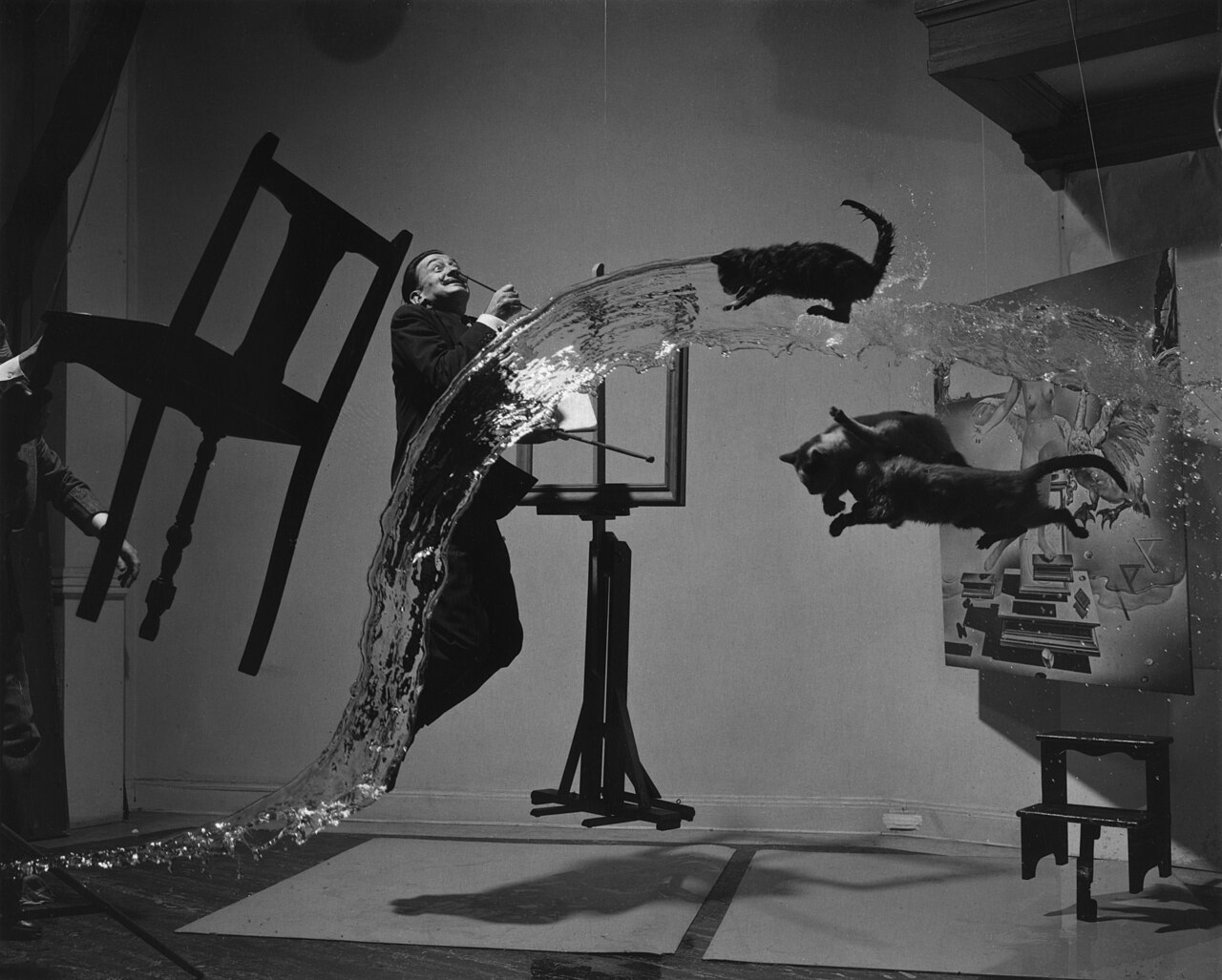
Dalí Atomicus — Salvador Dalí, three cats, a chair, an easel and a stream of water all suspended in mid-air in a single leaping composition.
Dalí Atomicus, 1948 — everything caught mid-flight, dream made photograph. Photograph Philippe Halsman · Public domain · via Wikimedia Commons
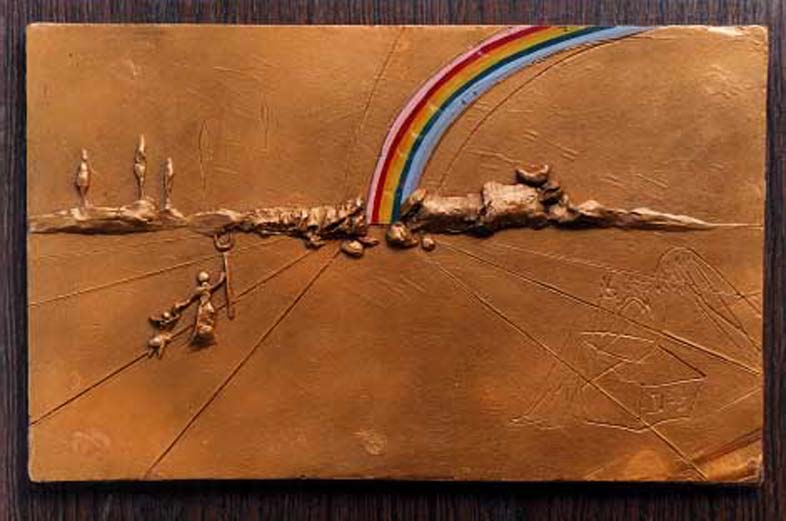
Salvador Dalí, The Rainbow (1972) — a dreamlike painting with a soft arc of colour over a barren surreal landscape.
The Rainbow, 1972 — late-Dalí, the marvelous still working. Art by Salvador Dalí · CC BY 3.0 · via Wikimedia Commons

§ 08 the register / les membres

No. 01
André Breton
No. 02
Louis Aragon
No. 03
Max Ernst
No. 04
Leonora Carrington
No. 05
Salvador Dalí

§ 09 mediums & archetypes

the manifesto automatic writing the exhibition the journal the exquisite corpse
Orpheus The Cell / Vanguard

§ 10 fate / la fin

Outlived its vanguard moment into respectable middle age; dissolved after Breton's death in 1966 — long since absorbed into mass visual culture. The dream escaped the office and went everywhere.

§ 11 sources & credits

Images reused from Wikimedia Commons under their stated licenses, with attribution:
· Dalí Atomicus (1948), photograph by Philippe Halsman — Public domain — source
· The Rainbow (1972), by Salvador Dalí — CC BY 3.0 — source

Text coded from public web sources (Wikipedia-led; confidence: medium, not yet independently verified): Bureau of Surrealist Research (Wikipedia) · Papillons (The Met) · The Bureau of Surrealist Research, 1924–25 (academia.edu) · 100 Years Ago (SuchFriends Blog)