Field notes
A rig, a
generator,
a refusal
Spiral Tribe compressed the entire logic of the early-1990s British free-party movement into a single mobile unit — a squat-honed work ethic and a mantra.
Formed in 1990 by Mark Angelo Harrison, Debbie Griffith, and Simone Feeney out of the squats of Westbourne Park and Ladbroke Grove, the collective treated the free party not as entertainment but as a total, self-organizing event — communal, unticketed, and explicitly hostile to the commodification of rave.
Between 1990 and 1992 they staged or played more than thirty parties, raves, and festivals, escalating from a week-long New Year's takeover of the derelict Roundhouse to the violently dispersed Acton Lane warehouse party of Easter 1992.
Their defining moment arrived unplanned. When police blocked travellers from reaching the Avon Free Festival in May 1992, the convoy diverted onto Castlemorton Common, and Spiral Tribe — alongside DiY, Bedlam, and Circus Warp — helped turn a week-long standoff into a spontaneous gathering of 20,000 to 40,000 people.
The mark
The spiral
& the 23
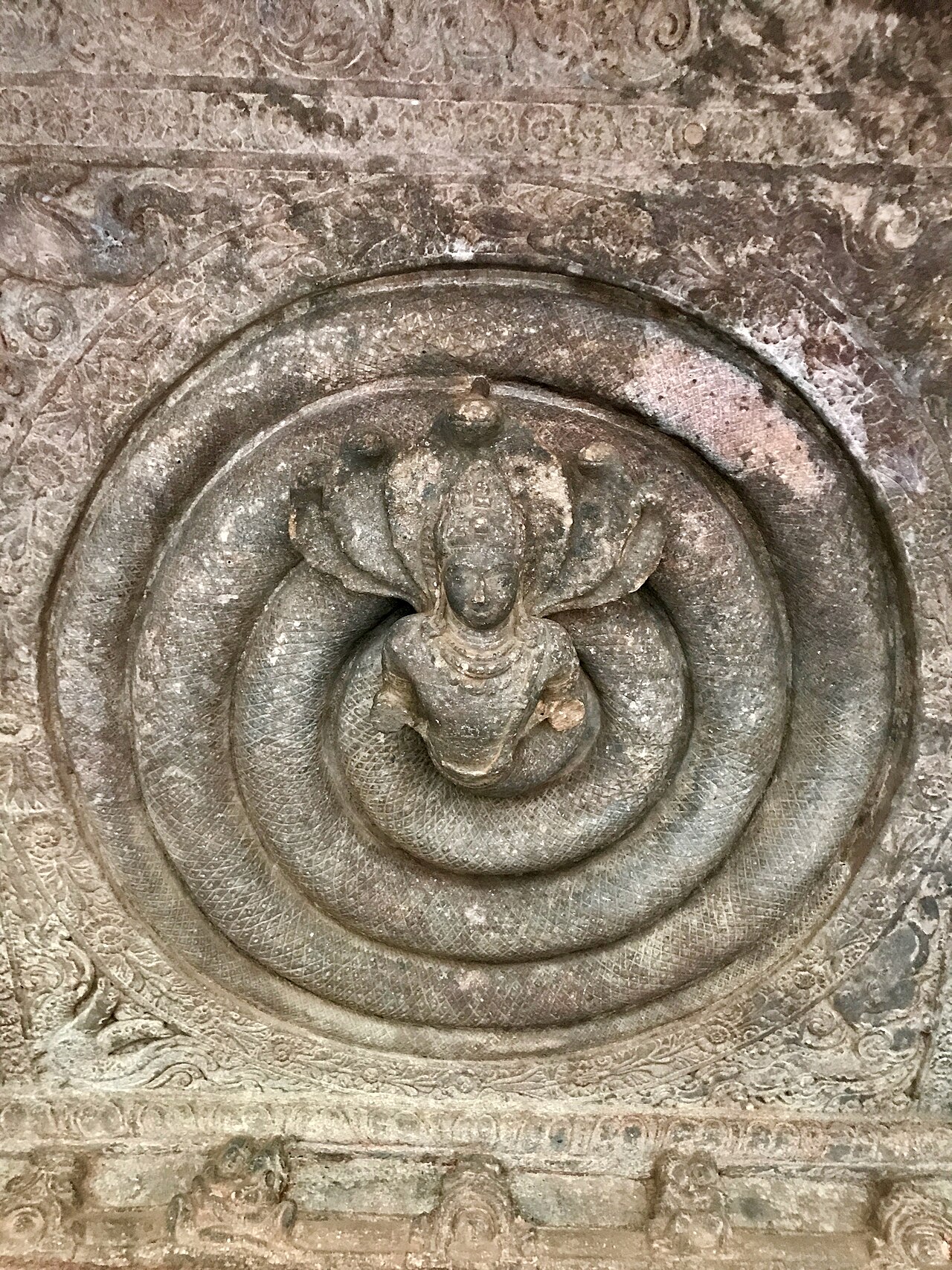
The crew took its emblem from the ammonite spiral — a coil that runs inward without end, a glyph for the endless party and the turning generator. It rode on every flyer and speaker stack beside the number 23, the tribe's recurring signature. The spiral was never decoration; it was the diagram of the thing itself — a self-organizing, ungovernable turning that would not stop.
- the nomadic sound system
- the free party as autonomous zone
- uncompromising refusal
- the teknival & the traveller convoy
,_Badami_Hindu_cave_temple_Karnataka.jpg)
Unifying principle
Memetic forces
What made
it spread
- Absolute refusal to commercialize or stop made the crew a legend and a cause.
- The collective nomadic life around the rig forged a total, tribal identity.
- Provoking the state — and the resulting law — turned parties into a political frontline.
Convergent engines
What held
it together
- The shared mobile sound-system rig.
- A nomadic communal lifestyle.
- An uncompromising free-party ideology.
A tight nomadic sound-system collective living around its rig — defined by refusal to compromise, and by the state repression that pursued it.
Divergent engines
Criminal Justice & Public Order Act 1994 — §63 "sounds wholly or predominantly characterised by the emission of a succession of repetitive beats"The state
wrote them
into law
The Castlemorton moral panic triggered a four-month, roughly £4 million trial that ended in acquittal for all thirteen defendants. The Criminal Justice and Public Order Act 1994 followed — legislation drafted, in effect, against a beat. Spiral Tribe became both martyrs and legislative catalysts, and then decamped to continental Europe.
- The UK's Criminal Justice Act (1994), targeting them directly.
- Forced exile scattering the crew across Europe.
- The tension between purity and survival.

Society impact
Exiled,
and it
spread
Spiral Tribe provoked landmark UK anti-rave legislation — and by scattering to the continent, seeded the European teknival and free-party movement that persists today. Refusal exported itself. The rig kept turning across borders long after Britain tried to switch it off.
52°04′N 002°17′W · Whitsun, May 1992
HEADCOUNT // 20,000 – 40,000
RIGS // Spiral Tribe · DiY · Bedlam · Circus Warp
DURATION // ~7 days · unticketed · non-stop
Scenius signature
A single uncompromising sound-system crew whose refusal turned parties into a cross-border movement and a legal flashpoint.
ARCHETYPE // The Autonomous Zone
FIGURES // (collective sound system)
Fate
Exiled from Britain by the CJA, it dispersed across Europe, seeding the teknival scene — its legend outlives the crew.
Image credits
[01] Coiled Nagaraja, Cave 1, Badami — Ms Sarah Welch — CC BY-SA 4.0 —
Wikimedia Commons
[02] Odaiba, Tokyo (elevated track) — User:Piotrus — CC BY-SA 3.0 —
Wikimedia Commons
Text compressed from public sources (Wikipedia-led; DJ Mag 2022; Minimal Collective interview with Mark Angelo Harrison; Grokipedia). Confidence: medium — not yet independently verified. Images are thematic stand-ins used under their Creative Commons licenses, not documentary photographs of Spiral Tribe.