Morphology
The Lab
Santa Fe, New Mexico 1984 – present The Laboratory · The Great Mind · The Invisible College
plectics · the science of the simple and the complex, together
An independent institute where physicists, biologists, and economists built the science of complexity and emergence — from the bottom up.
Founding wager
Rio Grande Institute → Santa Fe Institute · working brief
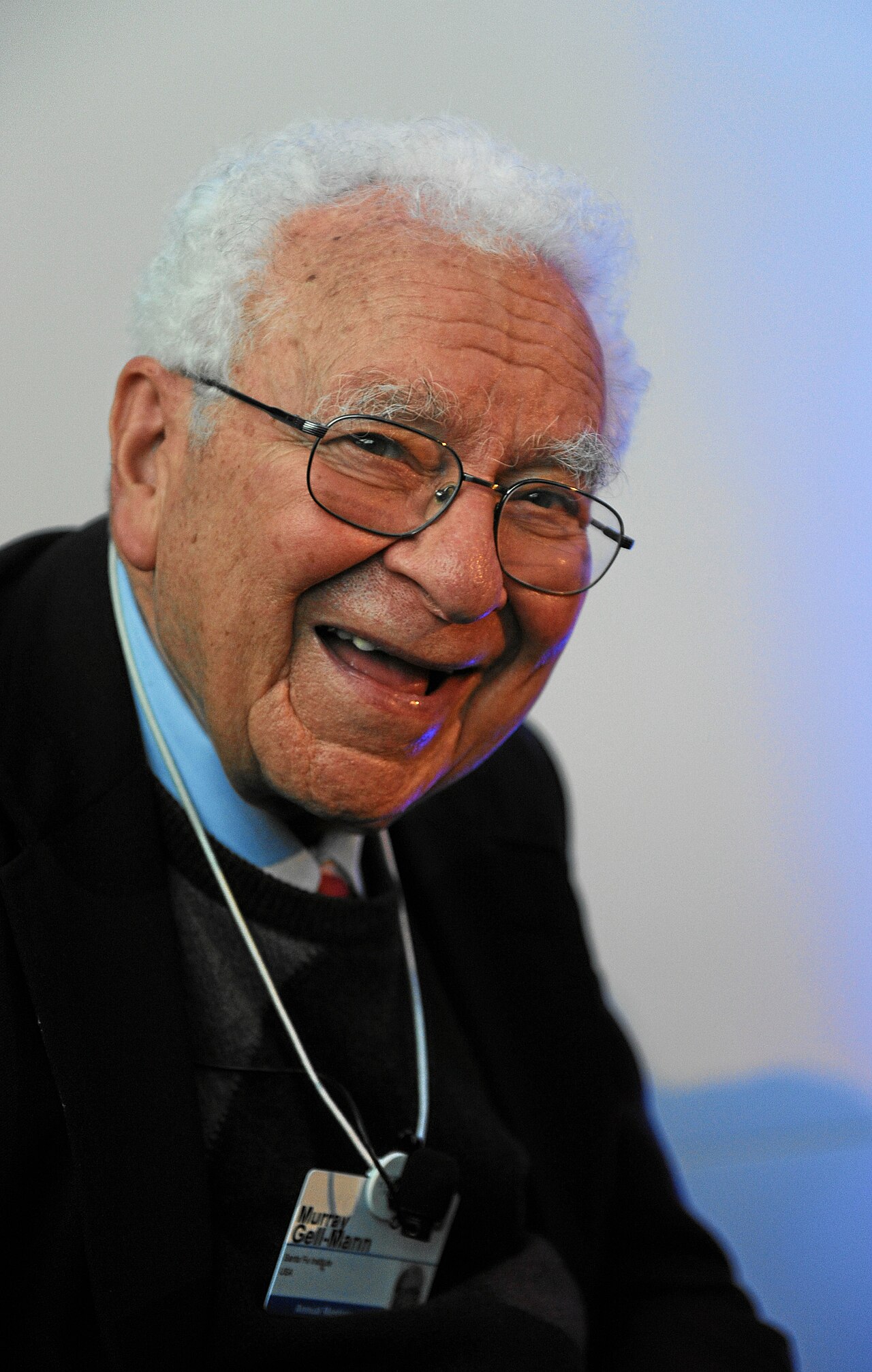
Founded in 1984 by Los Alamos chemist George Cowan, working with Nobel physicist Murray Gell-Mann, condensed-matter theorist David Pines, astrophysicist Stirling Colgate, and computing pioneer Nicholas Metropolis, the Santa Fe Institute was built as the world's first institution devoted exclusively to complexity science.
Its founding wager, sharpened over Cowan's informal early-1980s "Cowan Collaborative" gatherings, was that the mathematics and computational habits developed for particle physics and statistical mechanics could be exported wholesale into economics, evolutionary biology, immunology, and the social sciences — revealing shared laws of emergence, adaptation, and self-organization beneath superficially unrelated systems.
Briefly incorporated as the Rio Grande Institute, SFI became the durable institutional home for what Gell-Mann called plectics — the study of simplicity and complexity together.
The scenius signature
A building and a residency system designed so that a physicist and a biologist would collide at the coffee machine. No departments. No permanent faculty to speak of. Just visitors, workshops, and a hallway engineered for accident.
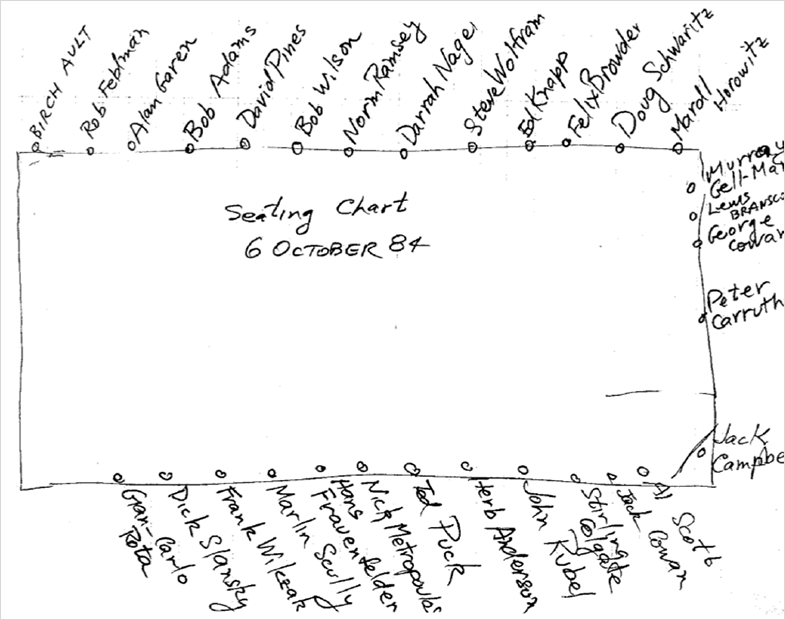
The relic beside this text is that principle at time zero — a hand-drawn seating chart from the very first workshop, 6 October 1984, when the place was still called the Rio Grande Institute. Names ring a single table: Gell-Mann, Cowan, Pines, Metropolis, Wolfram, Colgate, Gian-Carlo Rota. A single physical institute, built for collision.
Motifs
M·01
Emergence — complex order from simple local rules
M·02
The edge of chaos
M·03
Self-organization and adaptation
M·04
The toy model and the simulation
M·05
Trespassing across disciplinary borders
Memetic forces
The unifying principle
Complex adaptive systems — cells, brains, ecosystems, economies — share deep organizing principles that emerge from the interaction of many simple parts, and can be studied with common mathematical tools.
The dynamics
forces of coherence
forces of dispersal
Internal weather
How it runs
A deliberately small, non-departmental institute, engineered to force cross-disciplinary contact — running on visitors and workshops rather than permanent faculty, keeping ideas turning over.
Scenius signature
Institutionalized serendipity — a building and a residency system designed so that a physicist and a biologist would collide at the coffee machine.
The founders & fellows
Societal impact
SFI made complexity, emergence, and networks part of mainstream science and popular understanding — reshaping economics (increasing returns, agent-based models), biology (self-organization), and the study of networks and cities. Its habits of thought have been exported to dozens of imitator institutes around the world.
Mediums
Archetypes
Fate
Thriving and canonical. Complexity science is now a permanent — if still-contested — part of the scientific landscape, exported to dozens of imitator institutes.

