Internal dynamics
A loose intellectual current carried by a few visionary thinkers rather than an institution — transmitted through texts and influence more than membership.
A visionary Russian current holding that humanity's task is to conquer death, resurrect the dead, and colonize the cosmos.
A cosmology, not a school
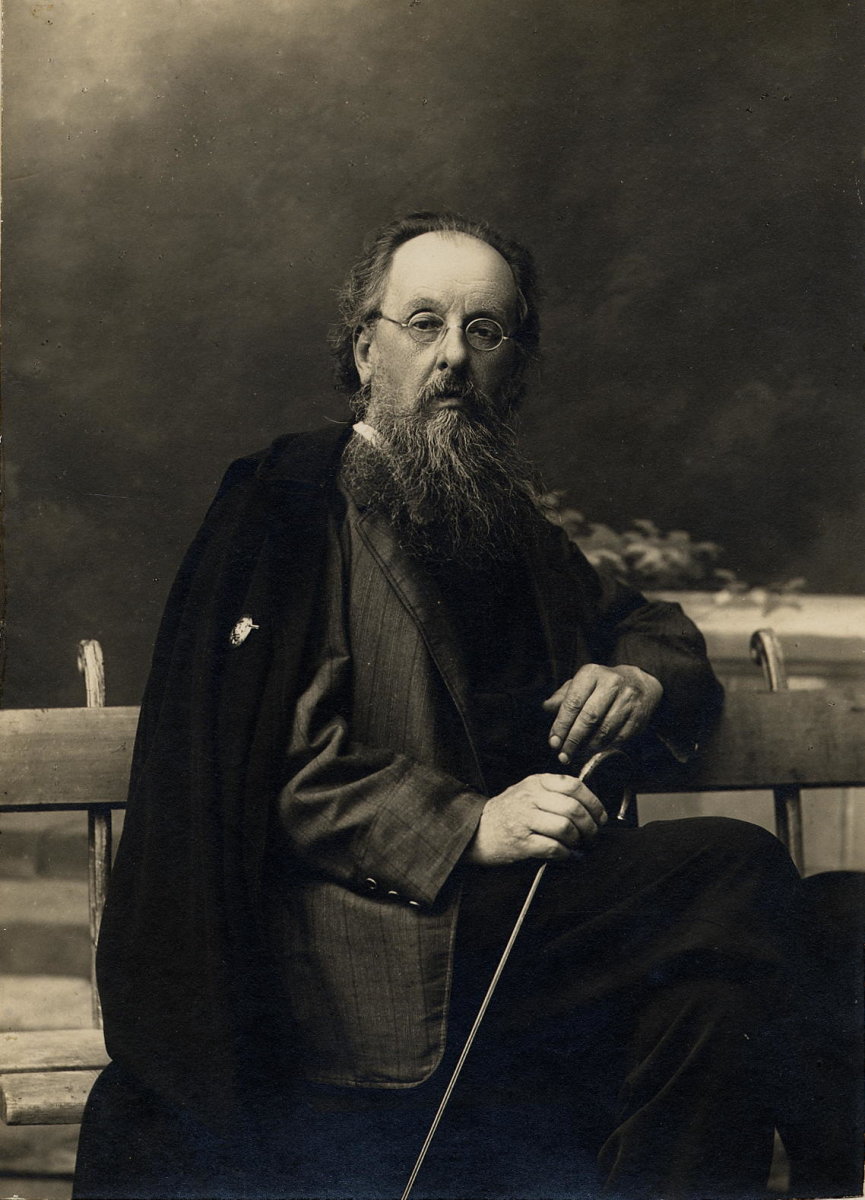
Russian Cosmism was less a school than a shared cosmology that spread through personal contact and correspondence in late-Imperial and early-Soviet Russia. Its founding conviction, articulated by Nikolai Fyodorov, was that death itself was a moral and technical problem: humanity's "common task" was to marshal science to physically resurrect every ancestor who had ever lived, and to expand outward into the cosmos to give them room and resources.
What began as one eccentric librarian's private metaphysics became, through disciples and admirers, a set of research programs — Tsiolkovsky's rocket equation and philosophy of spaceflight, Vernadsky's biosphere and noosphere, Chizhevsky's heliobiology, Scriabin's unrealized Mysterium — each translating the same eschatological demand (overcome finitude, unify mind and matter, regulate the cosmos) into a different discipline's vocabulary.
Death and the limits of the body are not final. The shared task is to master nature so as to resurrect the ancestors and spread life throughout the cosmos.
the unifying principle
Four recurring demands
The conquest of death and the resurrection of the dead.
Humanity's cosmic destiny and the colonization of space.
The "common task" uniting all of mankind in one project.
Technology as the completion of divine creation.
Why it spread
The sheer audacity of promising literal immortality and resurrection gave the idea an overwhelming, almost religious pull.
It fused Orthodox spirituality with radical science, appealing across the religious–secular divide.
Its cosmic scale reframed ordinary science — rocketry, biology — as steps toward transcendence.
What held it together — and pulled it apart
A loose intellectual current carried by a few visionary thinkers rather than an institution — transmitted through texts and influence more than membership.
It inspired the Soviet space program (Tsiolkovsky) and blood-transfusion science (Bogdanov), shaped the Russian avant-garde, and became a foundational reference for transhumanism and space utopianism.
A far echo
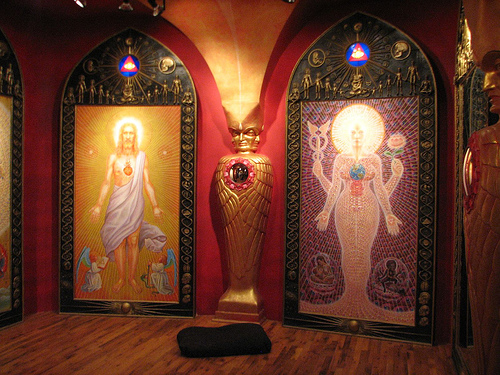
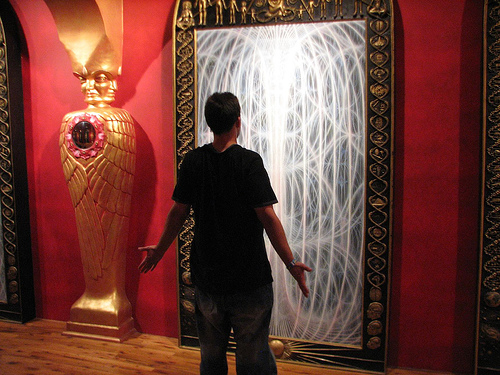
The cosmists have no surviving temple. But their central images — the resurrected ancestor, the body remade as light, mind fused with matter — resurface wherever visionary art reaches for transcendence. These panels are a contemporary echo, made a century after Fyodorov, not cosmist artifacts themselves: gilded arches and radiant figures that render literal what the cosmists demanded as a program.
A visionary current whose cosmic ambition reframed real science as the pursuit of immortality — ideas so large they organized a century of Russian futurity.
Its fate
Suppressed and dispersed under Stalinism, but resurfacing as a key ancestor of transhumanism, space philosophy, and contemporary art's cosmist revival.

