RAND Corporation
(early)
Abstract The Cold War think tank where game theory, systems analysis, and futures methods were forged as instruments of policy.
The Brief
The RAND Corporation, spun out of the U.S. Air Force in 1948 in Santa Monica, was the original Cold War think tank and an unlikely scene of intellectual ferment. Bringing mathematicians, economists, and engineers together to think about nuclear strategy, it became the crucible of game theory (via John Nash and others), systems analysis, operations research, the Delphi method, and scenario planning — new sciences of decision under uncertainty.
Herman Kahn's "thinking about the unthinkable" and Kenneth Arrow's impossibility theorem came out of this orbit. RAND's methods reshaped policy, management, and futures studies far beyond defense, and its early support helped birth the ARPANET; its rationalist, quantifying style is one of the century's most consequential and contested legacies.
Unifying Principle
Objects of Study
Fig. 1 — A two-player payoff schema
Illustrative only — a schema of the kind RAND analysts formalized, not a specific historical matrix. Each power's individually "rational" move is to escalate; the collectively rational outcome (mutual restraint) is the one the logic keeps abandoning. This gap is exactly what the house set out to quantify.
Memetic Forces
- Quantifying the unthinkable — nuclear war — gave anxious policymakers an illusion of control that funded everything.
- Cross-disciplinary brilliance under lavish, patient Air Force money attracted the best mathematicians and economists.
- The mystique of secret, rigorous, world-shaping analysis was intoxicating.
Engines — Convergent & Divergent
Convergent · what held it together
- Air Force funding and the Santa Monica campus.
- Interdisciplinary problem teams.
- New methods — systems analysis, Delphi, scenarios — as shared tools.
Divergent · what pulled it apart
- The gap between elegant models and messy reality (Vietnam).
- The moral revolt against "thinking the unthinkable."
- Talent dispersing into academia and government.
Internal Dynamics
A richly funded Cold War lab of star analysts given freedom and secrecy; its confidence in quantification was its power and, in Vietnam, its hubris.
Fig. 2 — The scenario, rendered as a ladder
A schematic of the war game and the scenario — the two mediums by which RAND made the future a thing you could rehearse rung by rung. Herman Kahn's method was to refuse to look away at any step.
Societal Impact
Birthed systems analysis, much of game theory's application, scenario planning, packet-switching (Baran), and the modern think tank; shaped nuclear strategy and public-policy method.
Personnel — Selected File
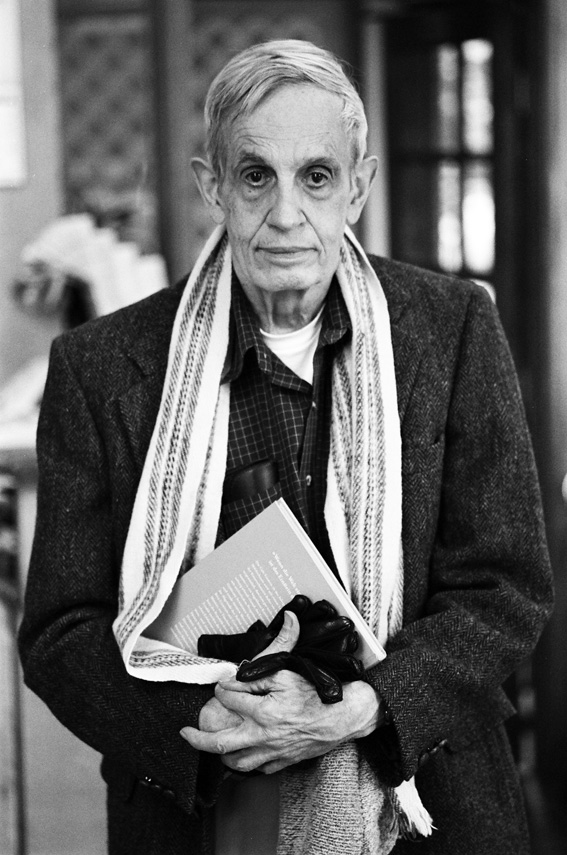
John Forbes Nash Jr. (1928–2015), mathematician and economist; his equilibrium concept became a load-bearing pillar of the game theory RAND put to work.
Photograph by Peter Badge / Typos1 · CC BY-SA 3.0 · source

the founding mind
equilibrium
escalation
social choice
Scenius Signature & Fate
Sources & Provenance
Keyed to the standard published literature on this scene — representative, not exhaustive; not independently re-verified against each edition.
- Alex Abella, Soldiers of Reason: The RAND Corporation and the Rise of the American Empire (2008)
- Fred Kaplan, The Wizards of Armageddon (1983)
- S. M. Amadae, Rationalizing Capitalist Democracy (2003)
Image Credit
Portrait of John Forbes Nash Jr. by Peter Badge / Typos1, licensed CC BY-SA 3.0. Source: Wikimedia Commons.
← return to the scenic garden