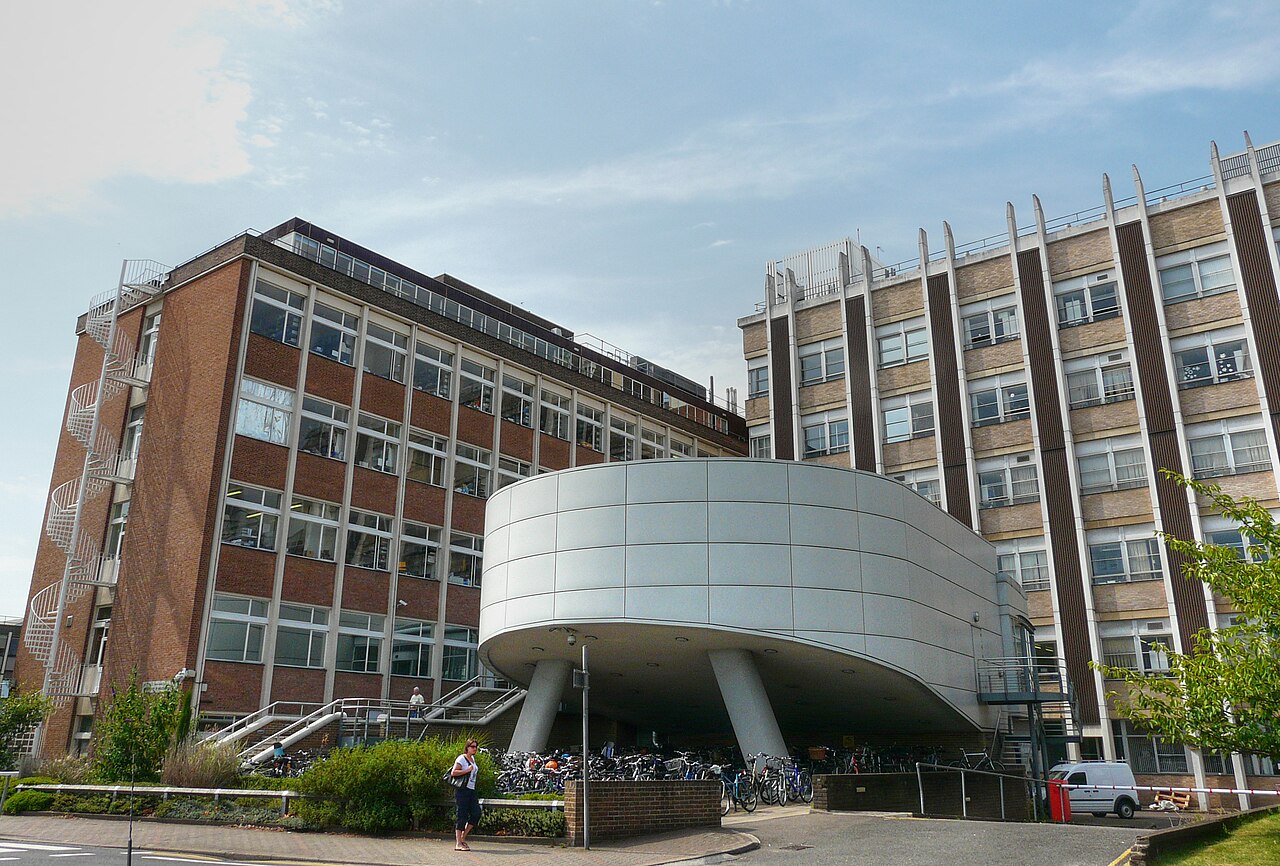

The specimen
The MRC Laboratory of Molecular Biology in Cambridge is, per Nobel Prize won, perhaps the most productive scientific building in history. Growing from the Cavendish unit where Watson and Crick found the double helix in 1953, and formally opened in 1962, it gathered Max Perutz, Francis Crick, Fred Sanger (twice a laureate), Sydney Brenner, and César Milstein under one roof — and, famously, around one canteen table where the day’s hardest problems were argued out over lunch. Protein structure, DNA sequencing, monoclonal antibodies, and the genetic code were worked out here. Its deliberate culture of interdisciplinary talk, patient funding, and flat hierarchy is the template every molecular-biology institute since has tried to copy.
The roll
Nobel density: five figures, one corridor.
// The hiring bar concentrated exceptional talent; proximity to world-historic discovery made the building a self-reinforcing magnet for ambition.
Recurring motifs
What the building kept returning to.
The double helix and protein structure
The canteen as the real seminar
Sequencing (Sanger) and monoclonal antibodies
Interdisciplinary problem-solving
Nobel density
Memetic forces
Why the ideas kept catching.
Proximity to world-historic discovery — DNA — created a self-reinforcing magnet for ambition and talent.
The famous shared canteen forced cross-disciplinary collision daily.
MRC’s stable, trusting, non-bureaucratic funding let people chase hard problems for years.
Unifying principle
“Concentrate outstanding people across disciplines, fund them stably and without bureaucracy, force them to eat and argue together, and let them attack the structure of life itself.”
Convergent & divergent engines
What held it together — and what pulled it outward.
Convergent — the gathering
- Stable, trusting MRC core funding
- The shared canteen and interdisciplinary layout
- A hiring bar concentrating exceptional talent
Divergent — the dispersal
- Success spinning off institutes and companies
- The scaling of biology into big consortia
- The pull of the discoveries into applied industry
Internal dynamics
Flat, patient, and centred on lunch.
A famously flat, canteen-centered lab where structural, molecular, and chemical biologists collided daily under patient funding; talk over lunch was the engine.
Scenius signature
A canteen where the century’s biology got argued into being over lunch, under funding patient enough to let it happen.
Impact on the world
The substrate of modern biology.
Solved the double helix, protein crystallography, DNA sequencing, and monoclonal antibodies — the substrate of genomics, structural biology, and biotech; the most Nobel-dense lab in science.
Fate
Thriving and endlessly imitated; its model — talent + freedom + forced collision — is the template every research institute now cites.
-
Keyed to the standard literature (representative, not exhaustive)
- Soraya de Chadarevian, Designs for Life: Molecular Biology after World War II (2002) — the definitive study.
- Horace Freeland Judson, The Eighth Day of Creation (1979).
- Georgina Ferry, Max Perutz and the Secret of Life (2007).