← the scenic garden
Par Avion · Air Mail · correspondance

Mail Art

The New York Correspondence School
1962–1995 Global (postal) Biome · Avant & Anti-Art Morphology · network

A global anti-market network that used the postal system itself as gallery, medium, and community.

Everyone is an artist Nothing is for sale
Exhibit A

The work that is also an instruction
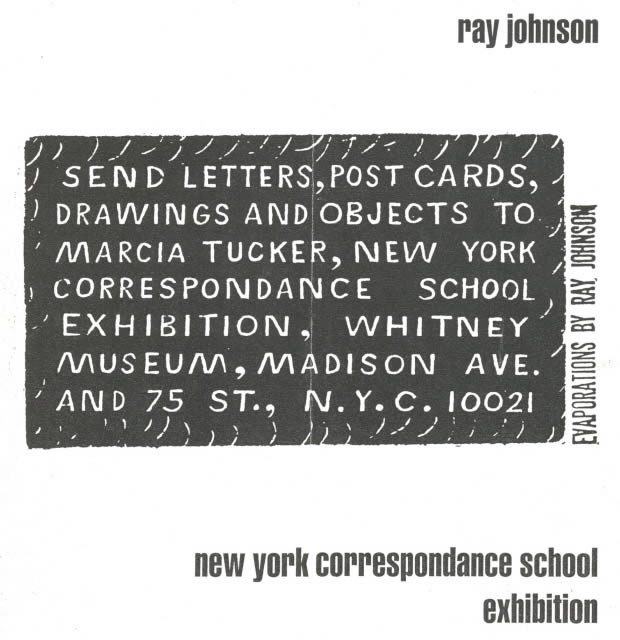
A Ray Johnson rubber-stamped invitation. Hand-cut block capitals inside a stamped panel read: Send letters, post cards, drawings and objects to Marcia Tucker, New York Correspondance School Exhibition, Whitney Museum, Madison Ave. and 75 St., N.Y.C. 10021. Vertical text at the side reads Evaporations by Ray Johnson.
Ray Johnson invitation, 1970. A rubber-stamped call that is itself a mail-art work: to attend is to send. Note the deliberate mis-spelling “Correspondance.”
Artist: Ray Johnson (deceased) · via Wikimedia Commons CC BY-SA 3.0

Ray Johnson did not exhibit. He mailed — drawings, collages, cryptic instructions, chains of “please add to and send to.” The gallery was the mailbox; the opening was the moment of delivery.

By the early 1960s that habit had a name of his own coining — the New York Correspondence School — and a founding law it never wrote down: no juries, no sales, no stars. The network itself was the artwork.

Rubber stamps, collaged postcards, artist stamps, and add-and-pass projects moved person to person, outside the galleries and the market, across Cold War borders that letters could cross when people could not.
Dispatch

What travelled in the envelope

To whom it may concern —

Mail Art was a decentralised global network, seeded by Ray Johnson’s New York Correspondence School in the early 1960s, that used the postal system itself as gallery, medium, and community. Rubber stamps, collaged postcards, artist stamps, and chain projects circulated person to person, outside galleries and the market, on the founding principle that everyone is an artist and no work is for sale.

Linked to Fluxus and Dada in spirit, it grew into a worldwide web of thousands of participants who mostly never met, trading work across Cold War borders. A genuine prefiguration of networked culture, mail art modelled the participatory, anti-commercial, many-to-many ethos that zine culture and later net.art would inherit.

Art should circulate as a free gift through a decentralized correspondence network — no juries, no sales, no stars. The network itself is the work.
— the one unwritten rule of the network —
Sheet 01

Recurring motifs — an artistamp sheet

01
The postal system as gallery
motif · medium
02
The anti-market gift
motif · ethic
03
The rubber stamp and the artistamp
motif · tool
04
Add-and-pass collaboration
motif · protocol
05
The correspondence network as artwork
motif · form
Why it travelled

Forces that carried it person to person

Belonging by participation

Mailing art free to strangers built an intimate global community with no gatekeepers — you belonged the moment you took part.

Anyone, anywhere

Cheap and open, it let anyone anywhere be an artist in the network — the price of entry was a stamp.

A proud alternative

The anti-commercial ethic gave outsiders a proud alternative to the gallery — refusal as identity.

Exhibit B

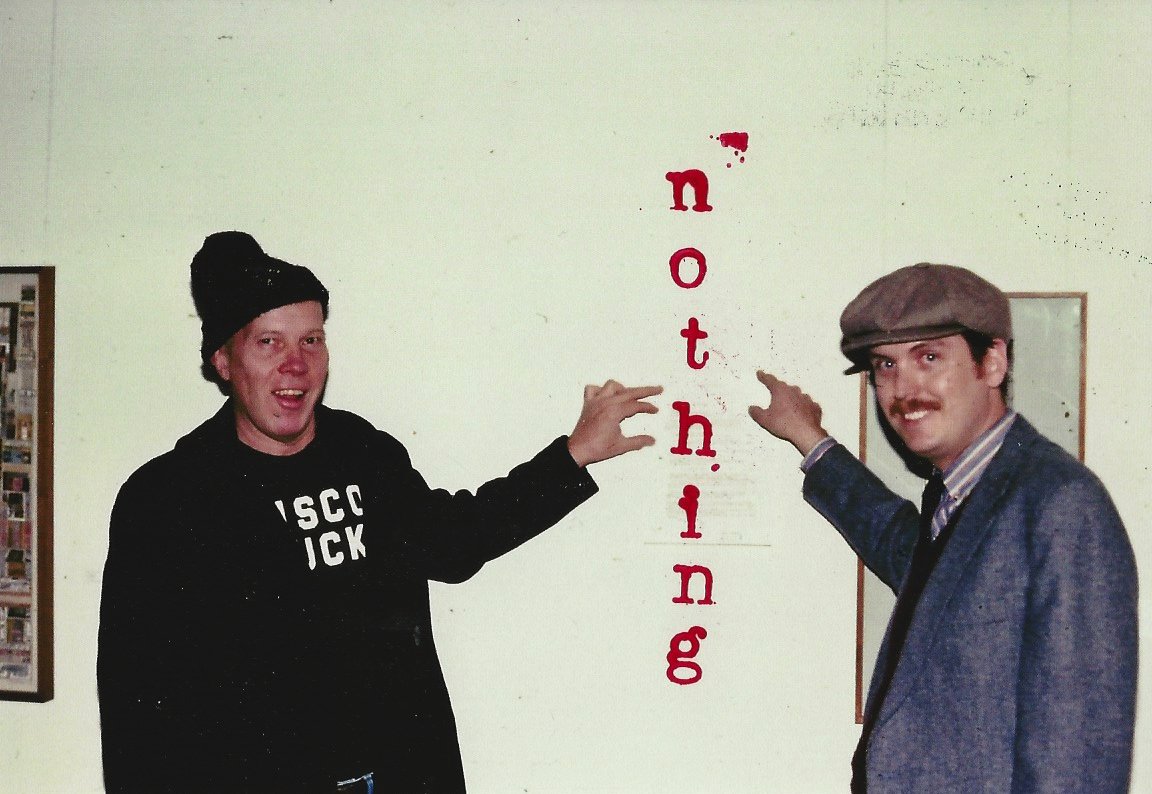
Pointing at nothing, proudly

“Nothing” was a running gag and a first principle at once. Nothing for sale, nothing to own, nothing to jury — just work in motion between people.

Here Ray Johnson and mail artist CrackerJack Kid (Chuck Welch) frame the word like a treasure. The network’s value lived in the sending, not the object; its economy was the gift.

Two men in a room stand on either side of the word NOTHING rubber-stamped vertically in red on a white wall. Both grin and gesture toward the word. On the left, a man in a dark hat and sweatshirt; on the right, Ray Johnson in a flat cap and grey jacket.
Ray Johnson and CrackerJack Kid, February 1984. The anti-market gesture, staged.
Artist: Charles D. Welch · via Wikimedia Commons CC BY-SA 4.0
Sorting

What delivered it — and what returned it to sender

Postmarked: delivered

  • Ray Johnson’s New York Correspondence School as seed.
  • The postal protocol as shared, standing infrastructure.
  • Open calls and the no-jury, no-return, no-fee rule.

Return to sender

  • A deliberate refusal to institutionalize — which capped its scale and its memory.
  • The death of Ray Johnson in 1995.
  • The migration of its logic to the internet.
Interior

How the network held itself together

Internal dynamics

A leaderless, protocol-bound network held together by the post and a gift ethic; its anti-institutional purity was its identity and its ceiling.

Scenius signature

A community constituted by a delivery system — scenius distributed across the whole postal map rather than gathered in a room.

Impact on the world

Prefigured net culture, zine networks, and social media’s participatory logic; kept a global anti-market art commons alive for decades.

Exhibit C

The network reads itself aloud

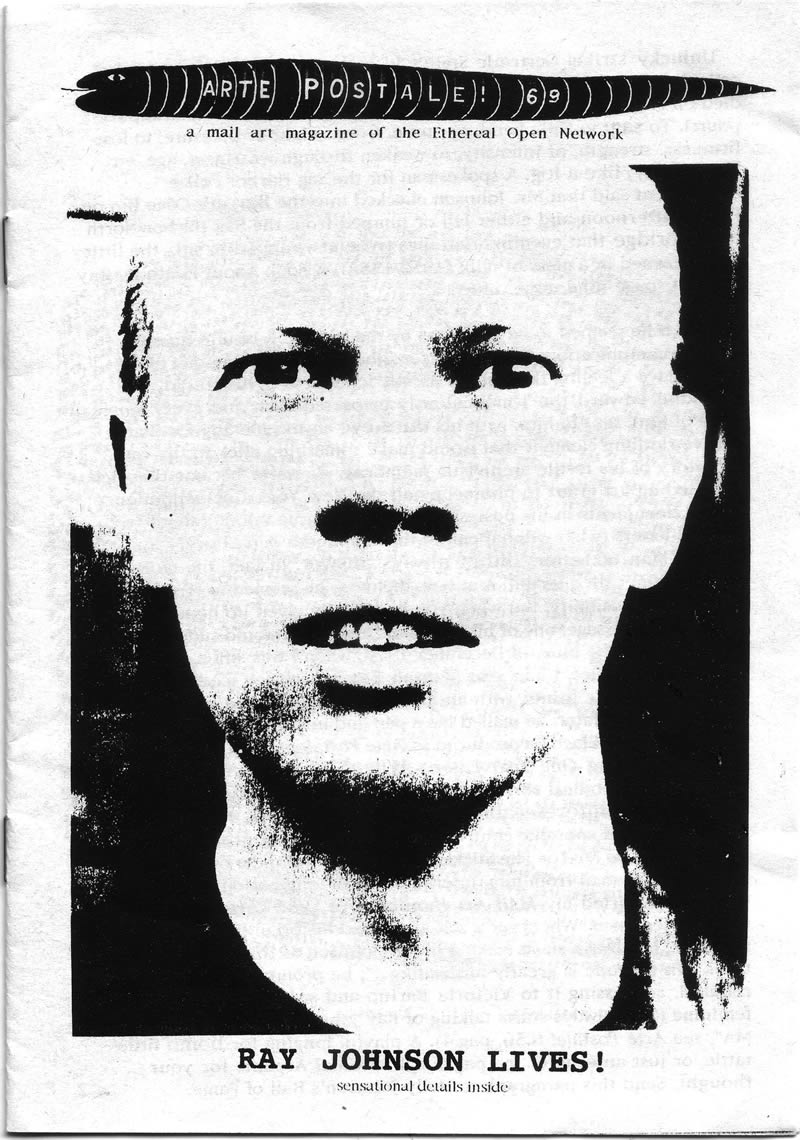
Xeroxed cover of the mail-art magazine Arte Postale! number 69, headed a mail art magazine of the Ethereal Open Network. A high-contrast photocopied portrait of a man's face fills the page. Bold type at the bottom reads RAY JOHNSON LIVES! and, smaller, sensational details inside.
Arte Postale! no. 69, “Ray Johnson Lives!” The high-contrast xerox aesthetic — cheap, copyable, mailable — was the network’s native print.
Editor / designer: Vittore Baroni · via Wikimedia Commons CC BY-SA 3.0

The zine was the network’s house organ: assembled from contributions mailed in, photocopied, stapled, and mailed back out. No printer, no publisher, no price.

Vittore Baroni’s long-running Arte Postale! is the archetype — a magazine made of the mail it received, its distribution list identical to its list of authors. The catalog and the community were one document.

That logic — participatory, copyable, many-to-many — is exactly what zine culture and later net.art would inherit.

Correspondents

Names on the list

Founder · the seed

Ray Johnson

Coined the New York Correspondence School; turned his own mailbox into a gallery and his collages into instructions. The network’s origin and its gravity.

Artistamps · the zine

Anna Banana

Publisher, performer, and tireless node — artistamps, banana-themed periodicals, and the organiser’s labour that kept open calls circulating worldwide.

Adjacent · the index

On Kawara

Not of the school, but kin in spirit: his “I Got Up” postcards and date paintings made time, presence, and the postmark into the artwork itself.

Mail art built its collages from exactly such stray, found photographs — a picture torn from anywhere, restamped, recaptioned, and posted on. Included here as a found image drawn into Anna Banana’s botanical iconography.

Backlit banana leaves against a bright blue sky, their green blades mottled with yellow and brown patches of damage.
Banana leaves damaged by Raoiella indica (red palm mite). A found image — the kind of stray photograph the network would collage and post on.
Artist: Amy Roda · via Wikimedia Commons Public domain
Kit

Mediums & archetypes

Mediums

the postcard the rubber stamp the zine the postal network

Archetypes

The Invisible College The Catalog / Index
Final delivery

Fate

Return to sender · addressee deceased
Ray Johnson · 1927–1995

Faded as the internet absorbed its function; survives as the direct ancestor of net.art and online participatory culture.

Postmarks & credits

All images are reused from Wikimedia Commons under the licenses stated. Each is credited to its author below.

Literature keyed to the standard published sources on this scene (representative, not exhaustive): Michael Crane & Mary Stofflet (eds.), Correspondence Art (1984); John Held Jr., Mail Art: An Annotated Bibliography (1991).