Three billion letters, read in public
The Human Genome Project, running from 1990 to 2003, was a globe-spanning public consortium that sequenced the roughly three billion letters of human DNA — one of the largest collaborations in the history of science.
Beyond the sequence itself, its most durable cultural achievement was procedural: the 1996 Bermuda Principles, which required that DNA data be released publicly within 24 hours, establishing open, immediate data-sharing as a scientific norm against the pull of privatization — embodied by its commercial rival, Celera. The Project launched the genomic era in medicine and biology, and modeled how huge, distributed, open scientific undertakings can work — a template for big, collaborative, data-intensive science.
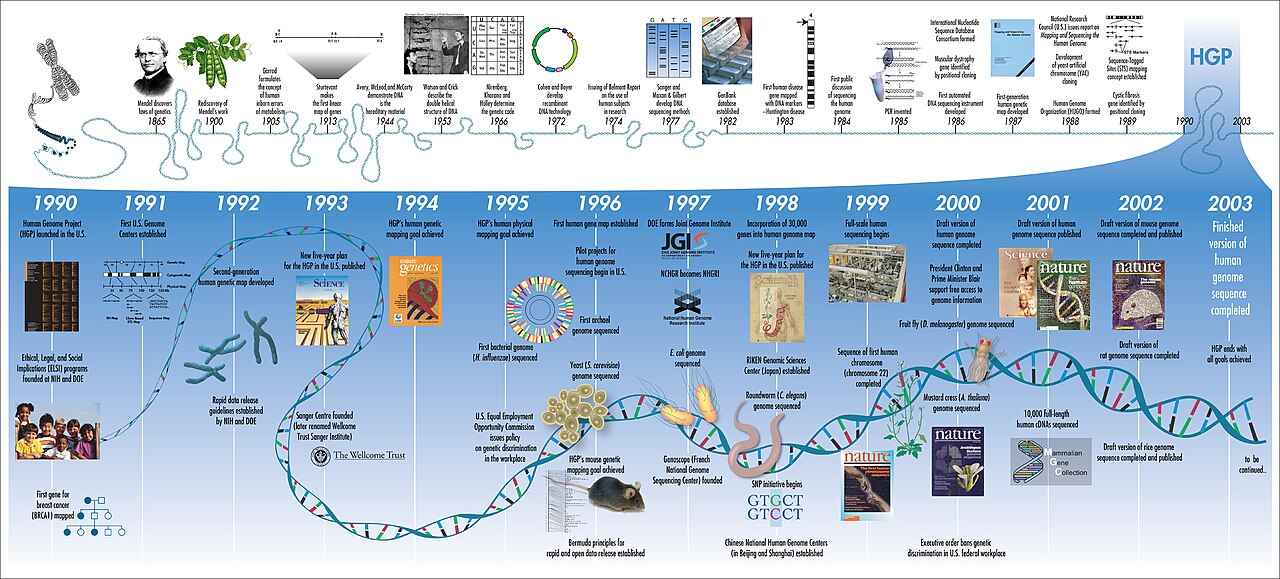
Credit: Darryl Leja, National Human Genome Research Institute (NHGRI), Bethesda, MD, USA · License CC BY 2.0
.jpg)
What recurred
- 001Asequencing the whole genome
- 002Cthe Bermuda Principles — immediate open data
- 003Gthe public-vs-Celera race
- 004Tbig-science biology
- 005Athe reference genome as commons
What made it spread
Reading the "book of life" was a civilizational milestone that mobilized nations and idealism.
The race with Celera created urgency and public drama.
The norm of instant open data release gave participants a shared moral cause.
Sequence the human genome as an international public good, releasing all data immediately and freely so the reference becomes a commons no one can enclose.
Every stretch of assembled sequence, deposited in a public database within a day of being read. Not published later — released nightly. The rule that turned a race into a commons, and held the coalition together against enclosure.
What converged, what diverged
Convergent · pulling together
- an international funded consortium
- the Bermuda Principles mandating daily open release
- industrial-scale sequencing centers
Divergent · pulling apart
- the private challenge from Celera over patents and data
- tensions among national centers
- the shift from one big project to dispersed genomics
A coalition, racing
A coordinated global consortium racing a private rival; its defining act was the collective commitment to open data against enclosure, which held the coalition together.
Society impact. It produced the reference genome and, crucially, the open-data norm — reshaping biology, medicine, and bioinformatics, and setting a precedent for scientific data commons.
A global consortium that sequenced the genome and, by giving the data away daily, kept the book of life a commons.
Completed in 2003; dissolved into the vast genomics enterprise it enabled, its open-data ethic now a scientific norm.
Figures
- (the sequencing consortium)the collective author
- John Sulstonthe Sanger Centre · UK
- Francis CollinsNHGRI · US
Mediums
- the consortiumorganizational
- the sequencerinstrument
- open data releaseprotocol
- the Bermuda Principlesnorm
Archetypes
- The Invisible Collegedistributed collaboration
- Prometheusfire, given freely
Image credits
- Plate 01 — "The Human Genome Project Timeline," Darryl Leja / National Human Genome Research Institute (NHGRI), Bethesda, MD, USA. Licensed CC BY 2.0 via Wikimedia Commons.
Keyed to the literature
- John Sulston & Georgina Ferry, The Common Thread (2002)
- James Shreeve, The Genome War (2004)
- Kevin Davies, Cracking the Genome (2001)