← the scenic garden Institut für Sozialforschung · est. 1923
A Scene in the Ecology of Scenius § Republic & Salon · Laboratory

Frankfurt
School Zeitschrift für Sozialforschung — critical theory in exile


Volume1923 – 1969
StandortFrankfurt / New York (im Exil)
DirektorMax Horkheimer
MethodMarx · Freud · Weber, negated

A funded institute that made social theory itself a critical practice, diagnosing the culture industry from inside exile.

Founded in Weimar Germany, driven out by the Nazis, reconstituted in Morningside Heights: a self-funded room of exiles who turned homelessness into the only vantage from which the whole could be seen — and indicted.

I The Institute

An analysis that turned the tools of social science back on society itself, and on the very idea of progress.

The Frankfurt School was the working name for the Institute for Social Research, founded in Weimar Germany in 1923 and reconstituted in New York exile after the Nazis drove its largely Jewish, Marxist membership out.

Under Max Horkheimer, Theodor Adorno, Herbert Marcuse, and the orbiting Walter Benjamin, it fused Marx, Freud, and Weber into ‘critical theory’ — an analysis that turned the tools of social science back on society itself, and on the very idea of progress.

Its diagnosis of the ‘culture industry,’ authoritarian personality, and one-dimensional consumer society gave the postwar Left its vocabulary. Returning to Frankfurt after the war, it seeded a second generation (Habermas) and, through Marcuse, became an unlikely oracle of the 1960s student movements.

Critical theory and cultural studies are its direct descendants.
II Motifs · the recurring figures of thought

The obsessions that returned in every issue.

  1. 01 the culture industry
  2. 02 reification and the administered world
  3. 03 negative dialectics
  4. 04 enlightenment turning back into myth
  5. 05 exile as vantage

III Unifying Principle · the negative

Reason has become instrumental and turned against emancipation; critique must be relentless and negative, refusing to supply the affirmative programs that ideology demands.

Memetic forceA theory that indicted mass culture itself flattered the alienated intellectual — and armed him against both capitalism and orthodox Marxism.
IndependenceFunding by the Weil grain fortune bought total independence from party and university.
StakesCatastrophe — fascism, exile, the camps — gave the work unbearable stakes and moral authority.
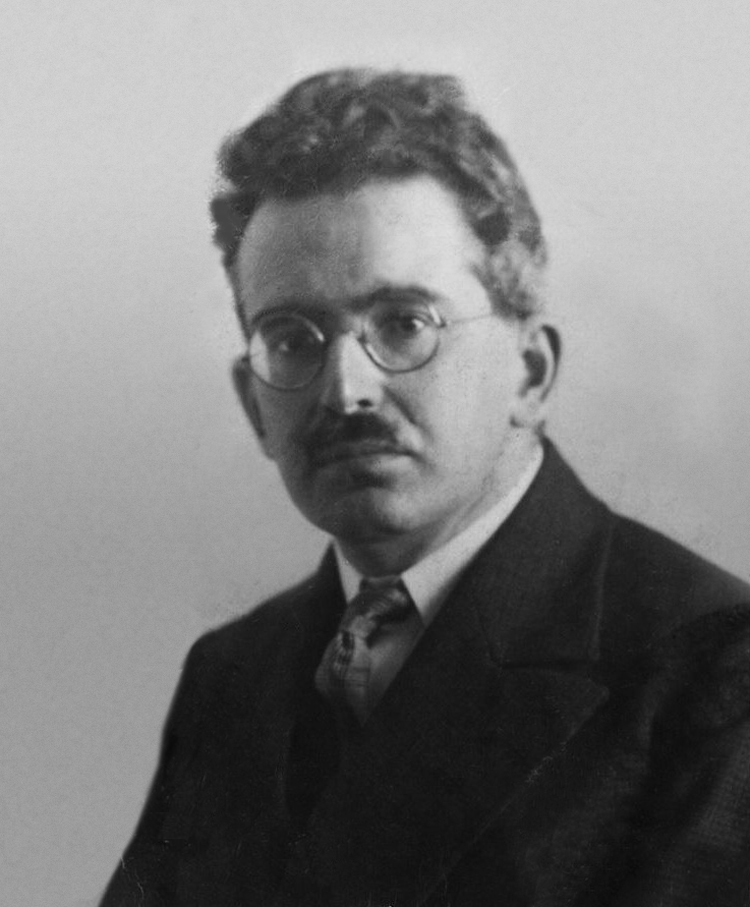
Plate I Sepia-toned 1928 portrait photograph of Walter Benjamin — bespectacled, dark-haired with a moustache, in a dark suit and patterned tie against a plain studio backdrop.

Walter Benjamin

The orbiting one. Never salaried, never quite inside, he pressed the Institute toward the redemptive charge in mass culture that Adorno could not accept — the school’s productive wound.

“Walter Benjamin en 1928.” Photo d’identité sans auteur, 1928. Public domain  · Wikimedia Commons

IV Engines · what bound and what split

A dialectic of cohesion and fracture.

+ Convergent

  • A funded Institute with its own journal and director (Horkheimer).
  • A shared Hegelian–Marxist–Freudian vocabulary.
  • The trauma of exile binding the core.

Divergent

  • The Adorno–Benjamin and later Adorno–Marcuse splits over mass culture and praxis.
  • The gap between American empirical sociology and German philosophy.
  • The 1968 students demanding action Adorno would not give.
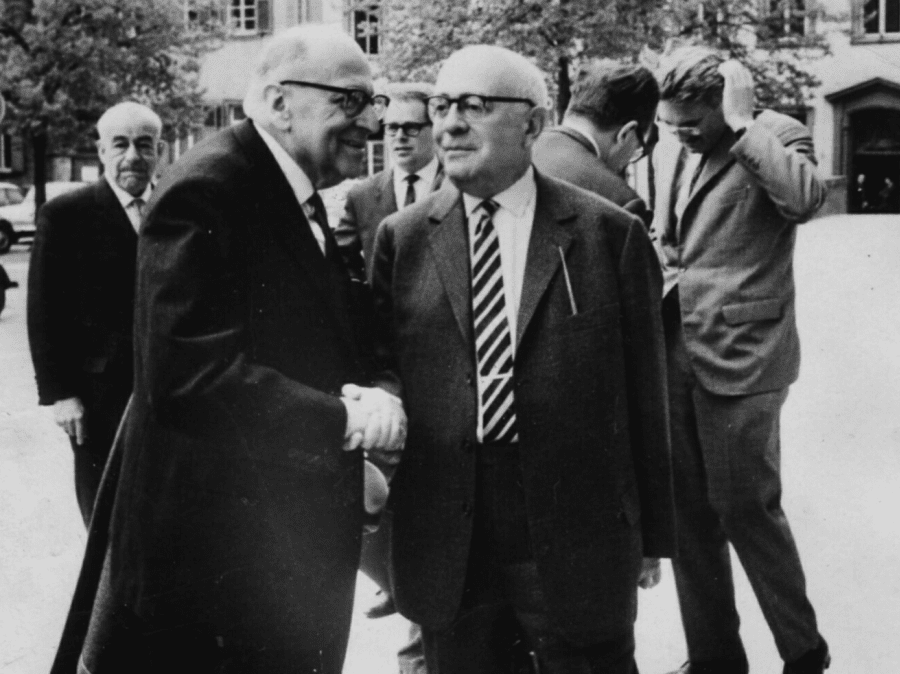
Plate II Black-and-white 1964 photograph in Heidelberg: Max Horkheimer at front left shaking hands with Theodor Adorno at front right, both in dark suits and glasses, with a young Jürgen Habermas visible in the background at right.

Horkheimer, Adorno & Habermas

Heidelberg, April 1964. Horkheimer’s purse and Adorno’s brilliance in the foreground; behind them, the second generation — Habermas, who would restore the affirmative program the founders refused.

Photograph by Jeremy J. Shapiro at the Max Weber-Soziologentag, Heidelberg, 1964. CC BY-SA 3.0  · Wikimedia Commons

V Internal Dynamics & Consequence

Internal dynamics and consequence

The room itself

A hierarchical institute run by Horkheimer’s purse and Adorno’s brilliance; membership was patronage, and its refusal of political praxis both preserved its rigor and estranged it from the movements it inspired.

Societal impact

Founded critical theory and the modern critique of media and consumer culture; seeded cultural studies, the New Left, and the permanent academic suspicion of the ‘culture industry.’

Scenius signature

A self-funded room of exiles who turned homelessness into the only vantage from which the whole could be seen and indicted.

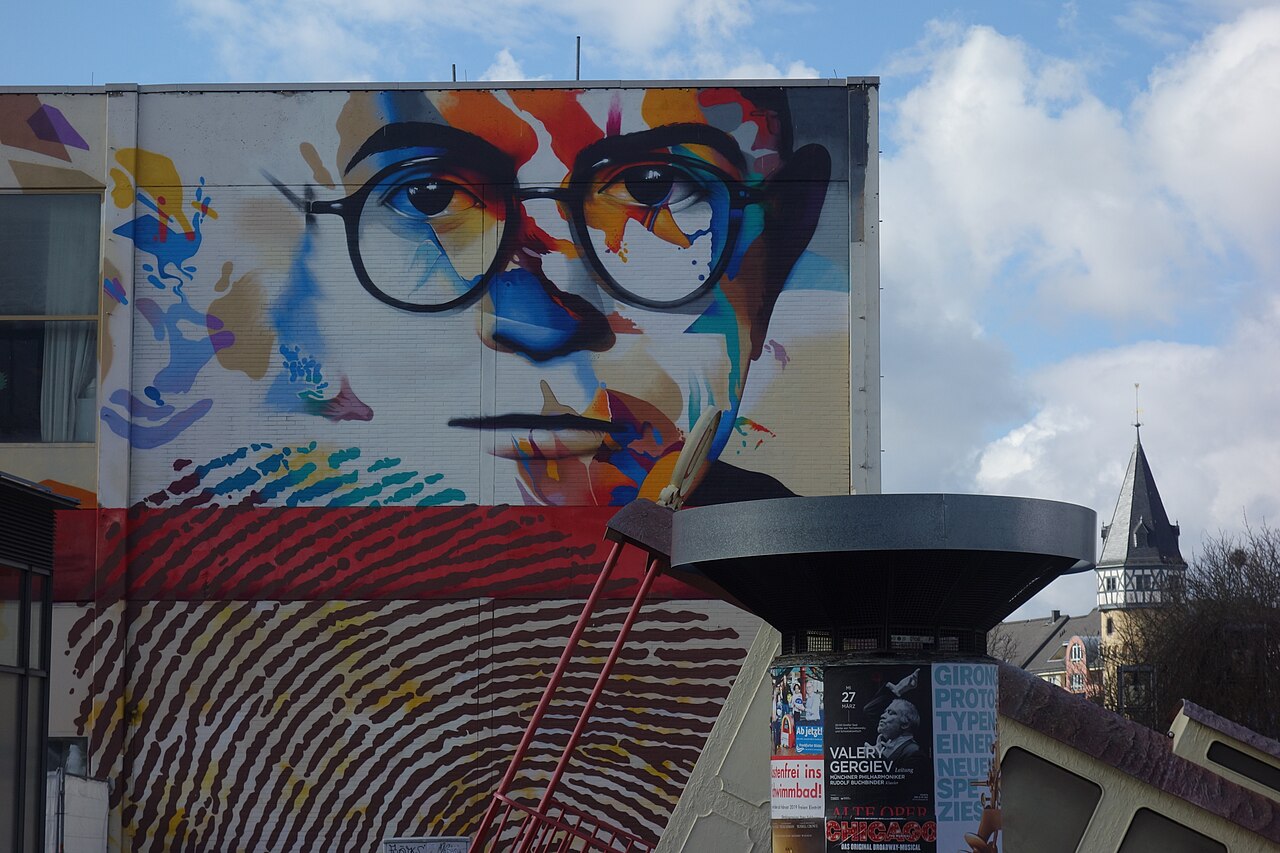
Plate III Large outdoor mural of Theodor Adorno's face rendered in vivid multicoloured brushstrokes on the side of a building in Frankfurt, with a red band and thumbprint-like patterns below, under a partly cloudy sky.

Theodor Adorno, in the city that outlived him

Returned to Frankfurt, the school institutionalized — and its severest critic of the image became one: a public mural on the Senckenberganlage, the culture industry rendering the man who named it.

Mural of Theodor Adorno by Justus Becker and Oğuz Şen, Senckenberganlage, Frankfurt. Photograph by Vysotsky. CC BY-SA 4.0  · Wikimedia Commons

VI The Editors

Core membership.

Theodor Adorno Max Horkheimer Walter Benjamin Herbert Marcuse

Mediums — the journal · the treatise · the essay   |   Archetypes — The Laboratory · The Invisible College

VII Fate

Returned to Frankfurt and institutionalized; passed to Habermas, who restored the affirmative, communicative program the founders had refused.

Keyed to the standard literature
  1. Martin Jay, The Dialectical Imagination (1973) — the definitive institutional and intellectual history.
  2. Max Horkheimer & Theodor Adorno, Dialectic of Enlightenment (1947).
  3. Stuart Jeffries, Grand Hotel Abyss: The Lives of the Frankfurt School (2016).