De Stijl
The world reduced to primary colors and right angles — a universal visual language of harmony.
De Stijl was less a school than a doctrine broadcast through a journal: a small, scattered group of Dutch painters, architects, and a poet united by Theo van Doesburg around Piet Mondrian's theory of Neoplasticism, reducing painting, furniture, and buildings alike to a single grammar of vertical/horizontal lines, rectangular planes, and the primary triad plus black-white-gray.
Its ambition was never merely stylistic but cosmological: to dissolve the boundary between art and life and produce, through abstraction, a visible image of universal equilibrium.
Doesburg
Mondrian
Rietveld
Reduction to primary colors, black, white, and the right angle.
The grid and dynamic equilibrium.
Abstraction as a universal spiritual language.
The dissolution of the boundary between the arts.
By reducing art to universal elements — primary color, straight line, right angle — the artist expresses a pure, objective harmony that should extend from painting into architecture and the whole environment.
- The utopian conviction that a pure visual language could harmonize society answered postwar Europe's hunger for order and renewal.
- Theosophical spirituality gave the geometry a transcendent, almost religious charge.
- The journal let a scattered handful project themselves as an international movement.
- The journal De Stijl as manifesto and glue.
- Van Doesburg's tireless organizing and evangelism.
- A strict shared visual vocabulary.
- The famous rupture between Mondrian and van Doesburg over the diagonal — a tilted line carried the weight of a schism.
- A loose, never-co-located membership.
- Van Doesburg's death (1931), which effectively ended it.
Internal Dynamics
A small international network coordinated largely through van Doesburg's journal and energy rather than a shared place, prone to doctrinal splits over seemingly small formal principles that carried great spiritual weight.
Societal Impact
Its grammar of primary colors and rectilinear abstraction shaped the Bauhaus, the International Style, modern graphic design, and minimalism — one of the most influential visual languages of the century.
A journal and a doctrine turning a handful of dispersed artists into a coherent international movement with an outsized formal legacy.
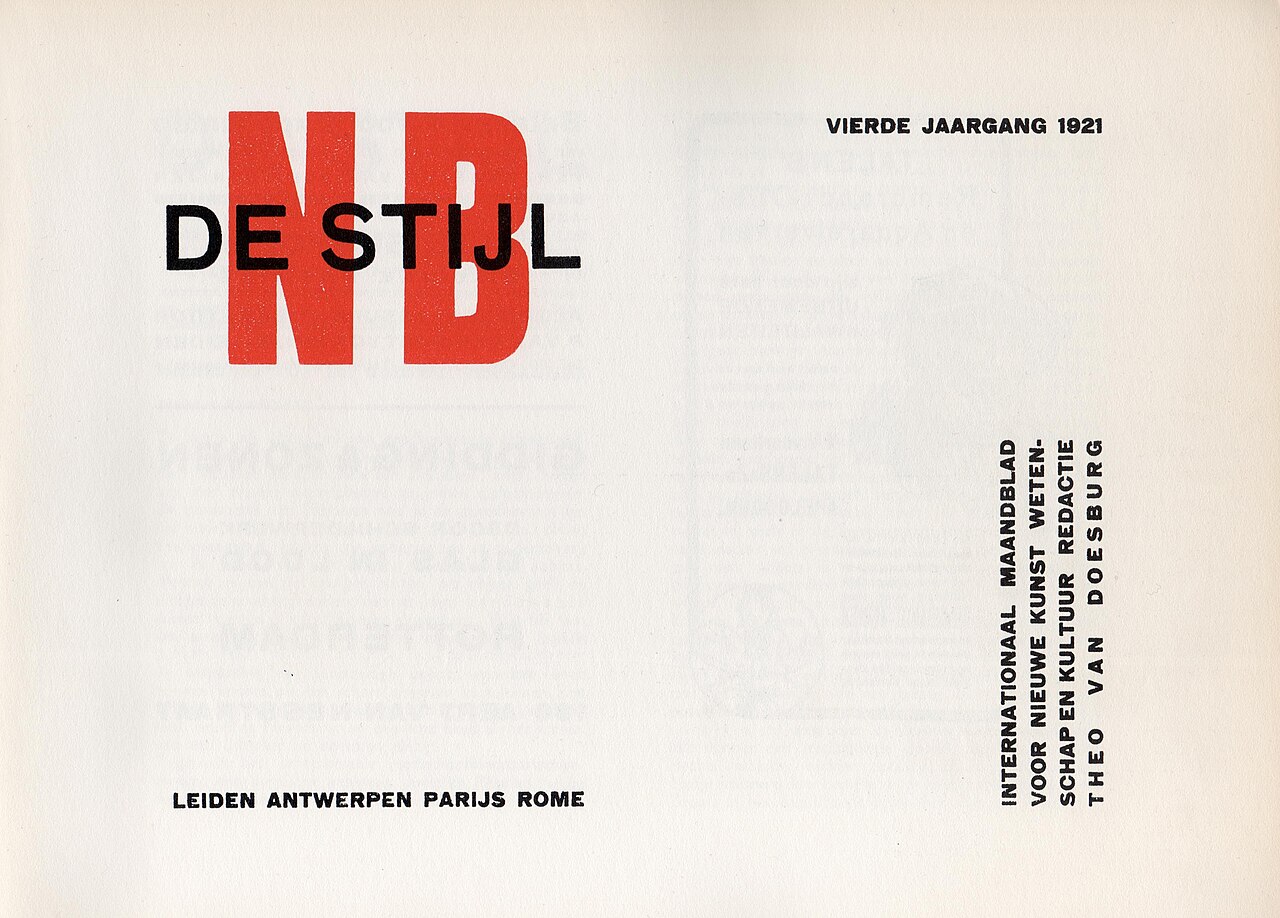
The journal that was the movement — type set as a Neoplastic composition, Leiden / Antwerpen / Parijs / Rome.
Artist: Theo van Doesburg / Piet Mondrian. License: Public domain. Source: Wikimedia Commons.

Ended with van Doesburg's death, but its forms were absorbed so completely into modern design that they became invisible — universal grammar.
Sources
- ‘De Stijl,’ Wikipedia (accessed 2026). en.wikipedia.org/wiki/De_Stijl — history, membership, founding, journal, schism, end date.
- ‘De Stijl,’ Encyclopaedia Britannica. britannica.com/topic/De-Stijl-art — Neoplasticism, style principles, key figures.
- ‘Building De Stijl Style,’ JSTOR Daily. daily.jstor.org/building-de-stijl-style — Theosophical / metaphysical context.
- ‘De Stijl Art Movement,’ Artlex. artlex.com/art-movements/de-stijl — vocabulary and later influence.
Coded from public web sources (Wikipedia-led); not yet independently verified. Image credited above is public domain via Wikimedia Commons.