the scenic garden

Soviet Russia · 1917 – 1930 · Form & Workshop

Construct­ivism& Proletkult

Artists who abolished "art" to become engineers of a new revolutionary reality — and a movement to forge proletarian culture from scratch.

Era1917–1930
PlaceSoviet Russia
BiomeForm & Workshop
MorphologyNetwork
Generativity5 / 5
01 / THE WAGER

Not to depict the new world — to build it.

Sculpture tried to become architecture. Painting tried to become propaganda. The museum was to be superseded by the factory.

Constructivism and Proletkult together named a single wager: that the Revolution demanded not just new political forms but a new visual, material, and pedagogical order to replace bourgeois easel painting entirely. Vladimir Tatlin and Alexander Rodchenko, working from abstract experiments as early as 1915, reframed the artist as an "artist-engineer" who constructs with industrial materials — glass, steel, wire, plywood — rather than composes illusions on canvas. Alexander Bogdanov's Proletkult, founded in 1917 and rooted in his tektology (a general science of organization dating to 1904), supplied the ideological chassis: a mass, self-organized proletarian culture built in parallel with — and sometimes against — the Bolshevik party-state. The result was a compressed, furious fifteen years.

02 / THE BRIGADE

Artist-engineers of the collective

  1. 01 Vladimir Tatlin
  2. 02 Alexander Rodchenko
  3. 03 Varvara Stepanova
  4. 04 Alexander Bogdanov / Proletkult
  5. 05 El Lissitzky
03 / MOTIFS

The grammar of construction

  1. The artist as engineer / constructor — not creator
  2. Faktura — truth to materials
  3. The flat plane, the diagonal, the photomontage
  4. Art dissolved into production and daily life
  5. Culture built by and for workers
04 / MEMETIC FORCES

Why it caught

01

The Revolution offered the ultimate stakes: not to depict the new world but to literally build it.

02

The erasure of the bourgeois "artist" let a generation reinvent their own role and status.

03

Bogdanov's dream of an autonomous proletarian culture gave workers ownership of the future.

Unifying principle

Art must abolish itself into life. The artist becomes a producer serving the collective. A new class must create an entirely new culture — not inherit the old.

05 / ENGINES

What pulled together / what tore apart

Convergent

  • The Revolution as a single galvanizing event
  • State studios (VKhUTEMAS) and mass Proletkult organizations
  • A shared enemy: bourgeois easel-painting and the museum

Divergent

  • Lenin's suspicion of Proletkult's autonomy — subordinated 1920
  • The split between pure Constructivists and Productivists
  • The tightening grip of the state toward Socialist Realism
06 / DYNAMICS & IMPACT

Utopia inside a hardening state

Internal dynamics

Utopian energy operating inside a hardening one-party state. The movement's fate was decided less by internal schism than by the Party's shifting tolerance — which first empowered and then crushed it.

Impact on society

Invented modern graphic design, photomontage, and agitprop; supplied the visual language of revolution worldwide; and posed, permanently, the question of whether a class can build its culture deliberately.

Scenius signature

Total conviction that design was world-building — backed briefly by a state willing to hand artists the actual levers.

Medium · the poster Medium · the productivist object Medium · agitprop Medium · the workers' studio
Archetype · The New Man Archetype · The Cell / Vanguard Archetype · The Guild / Workshop
07 / THE EVIDENCE

Objects of the new world
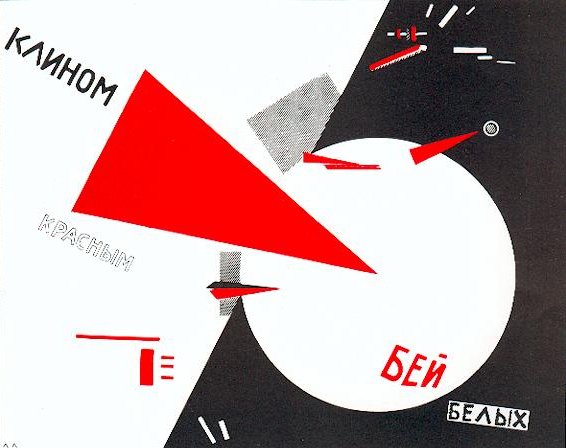
El Lissitzky's 1919 poster: a sharp red triangular wedge driving into a white circle on a black-and-grey field, with scattered Cyrillic lettering and geometric debris.
PLATE I

Beat the Whites with the Red Wedge

El Lissitzky, 1919. Suprematist abstraction weaponised into propaganda: the Red Army as a wedge splitting the White circle. The emblem of the whole movement — pure geometry made to act on history.

El Lissitzky · Public domain · via Wikimedia Commons

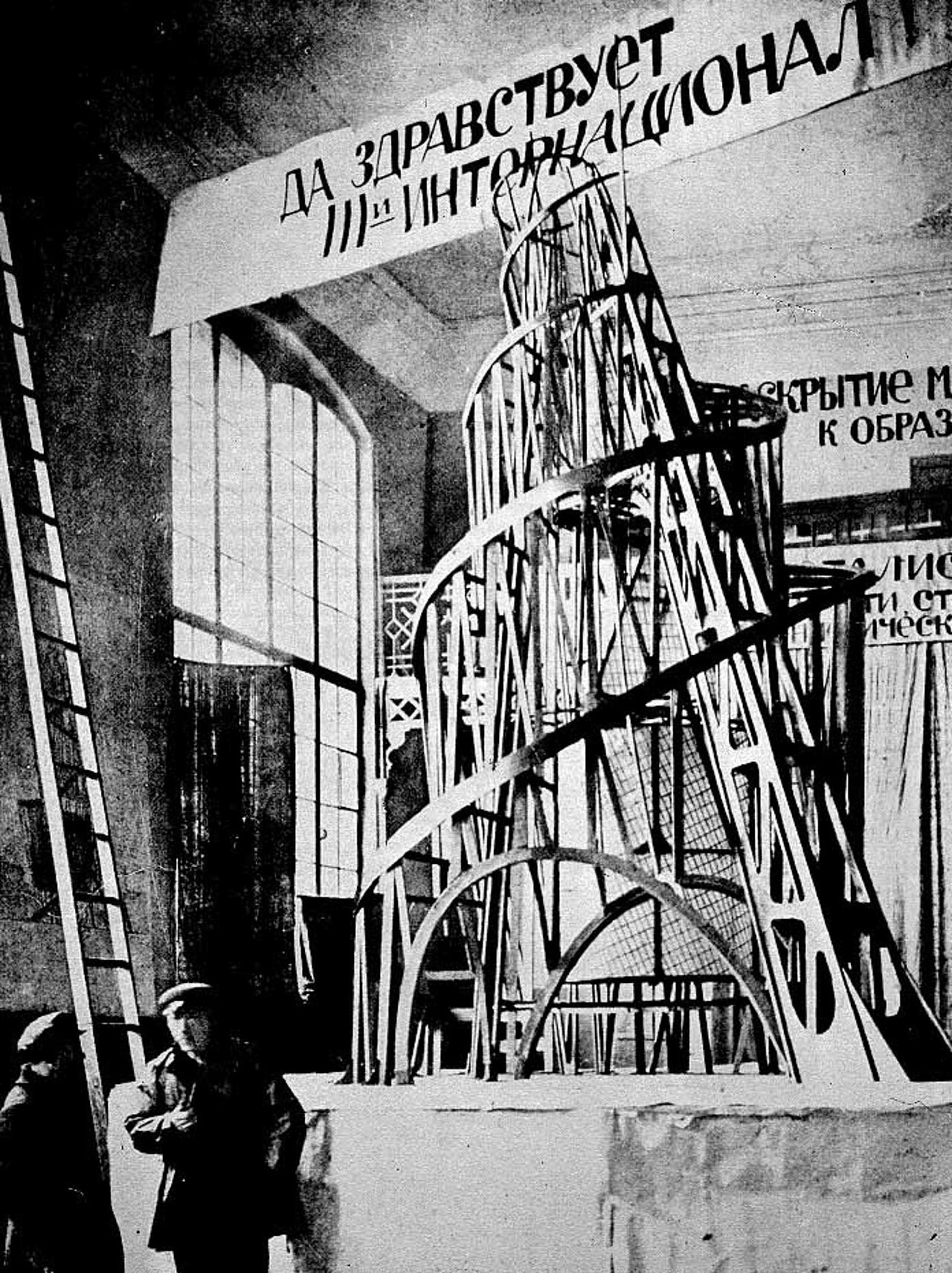
Black-and-white 1919 photograph of the wooden model for the Monument to the Third International — Tatlin's Tower — a leaning spiral lattice; Tatlin and an assistant stand beside it beneath a banner.
PLATE II

Monument to the Third International

Vladimir Tatlin's "Tower," 1919 — the model with the artist beside it. A leaning iron-and-glass spiral, meant to out-build the Eiffel Tower and house the Comintern in rotating volumes. Sculpture straining to become architecture, and architecture to become government.

Unknown author · Public domain · via Wikimedia Commons
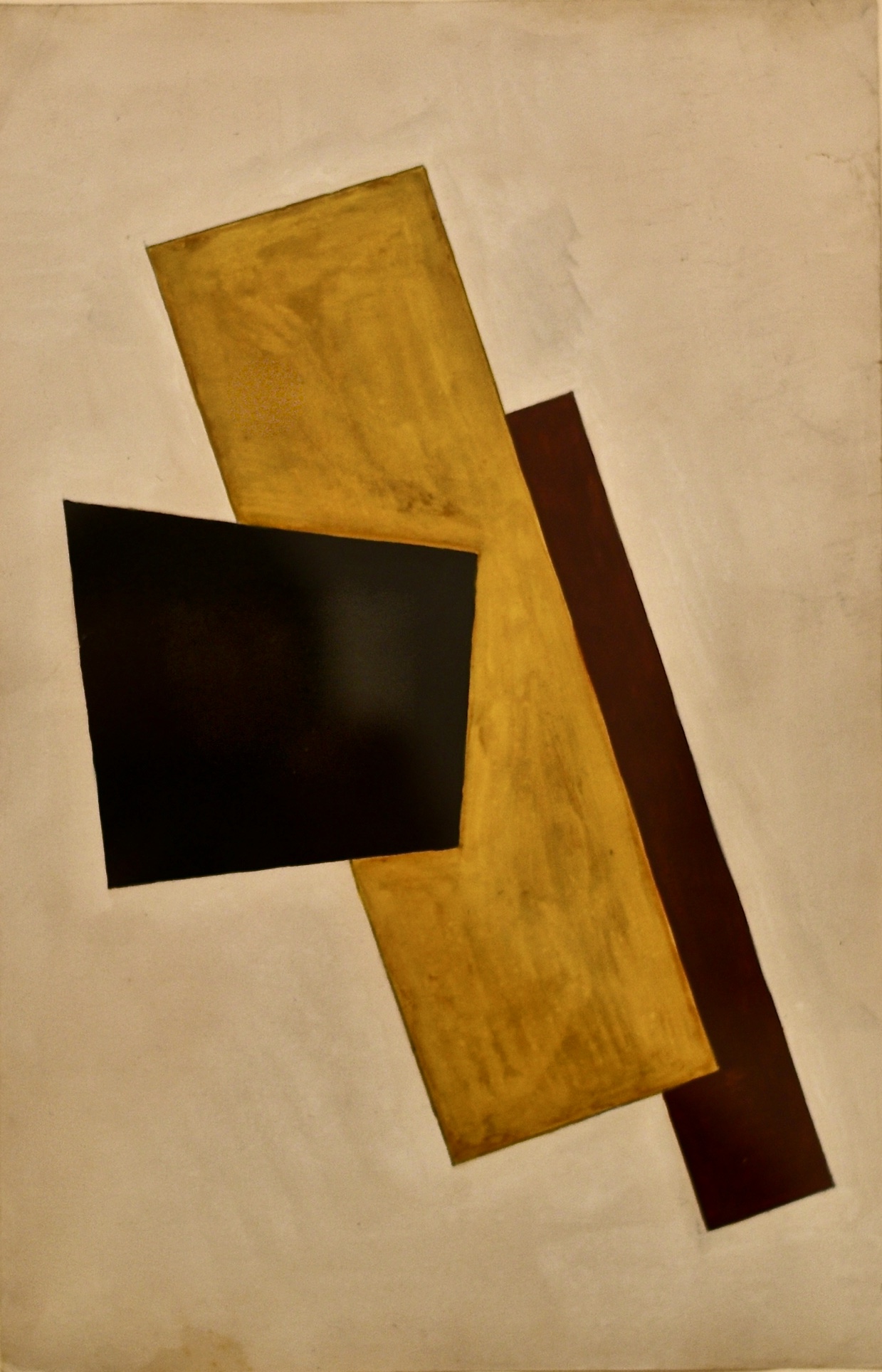
Liubov Popova's Composition (1917), gouache on paper: interlocking angular planes in gold, black and dark red set at diagonals on a cream ground.
PLATE III

Composition

Liubov Popova, 1917 (gouache on paper, Berardo Collection). Cubist, Suprematist and Constructivist force lines colliding — the laboratory phase, where dynamic planes were tested before the artists turned to production.

Photograph: Pedro Ribeiro Simões (Lisboa, Portugal) · CC BY 2.0 · via Wikimedia Commons

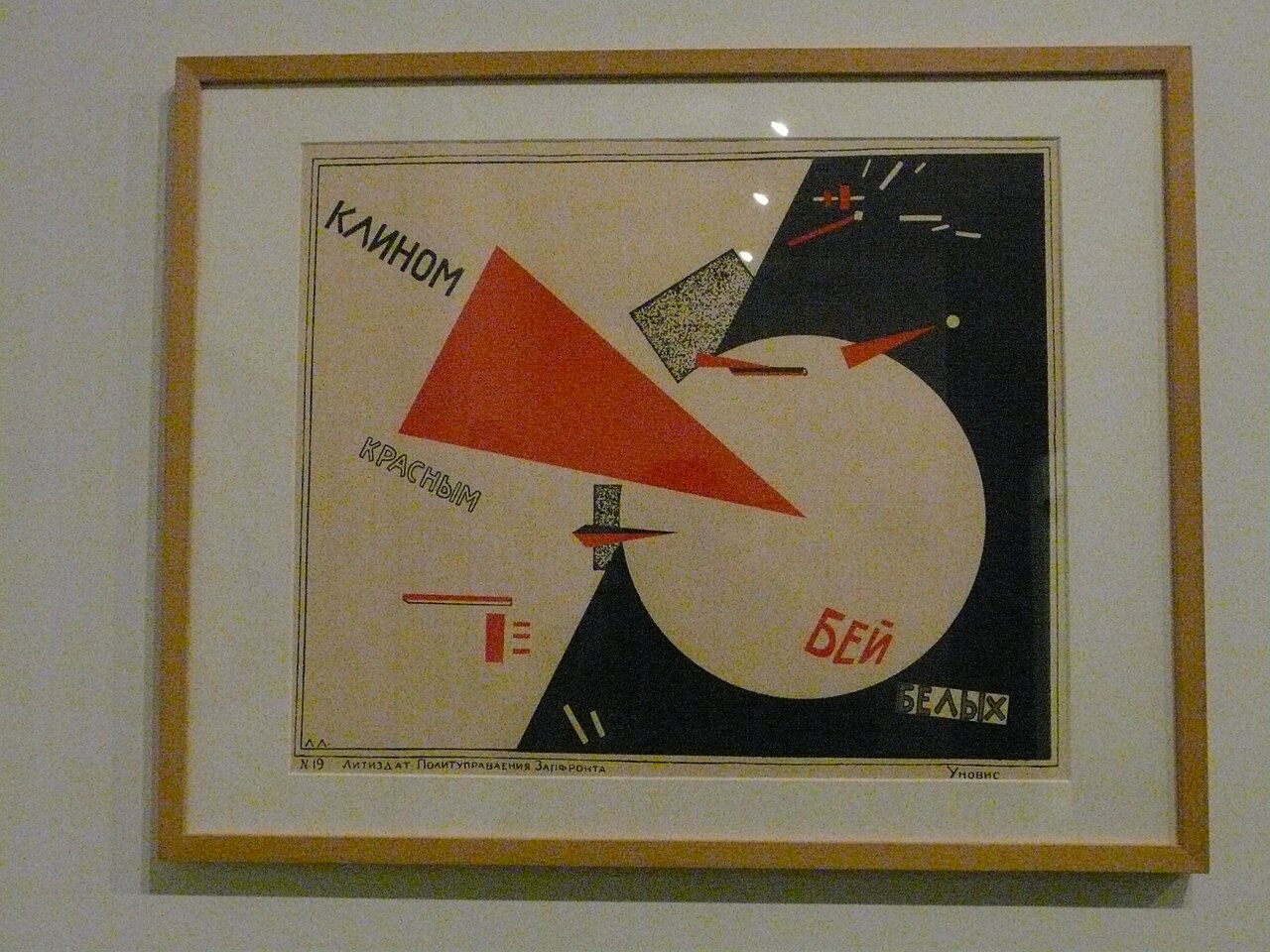
A framed print of El Lissitzky's Beat the Whites with the Red Wedge hanging on a gallery wall, its red triangle rendered in a warm orange tone.
PLATE IV

The Red Wedge, hung

The same lithograph as an exhibited object — proof of the after-life the Constructivists distrusted. The propaganda sheet, meant for the street and the front, ends framed on a museum wall.

Photograph: G.Lanting · CC BY-SA 4.0 · via Wikimedia Commons

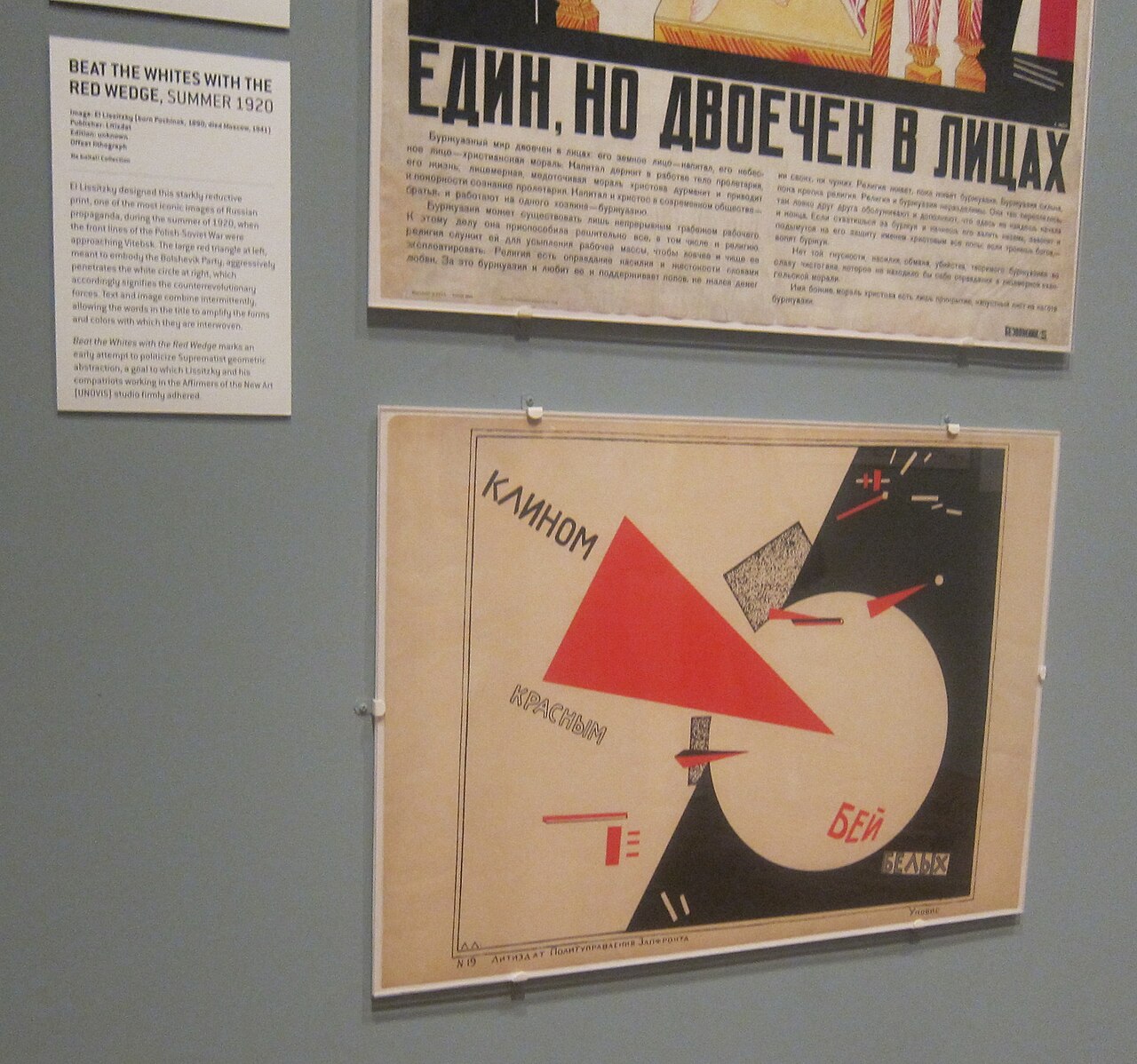
Museum display: El Lissitzky's Beat the Whites with the Red Wedge mounted beside a bold Cyrillic agitprop broadside and an English wall label explaining the work.
PLATE V

Wedge, broadside, label

The poster in context beside a mass agitprop broadside — the printed sheet doing the movement's real work: cheap, reproducible, aimed at everyone. This is where painting became graphic propaganda.

Photograph: Linzchris · CC BY-SA 3.0 · via Wikimedia Commons

08 / FATE

Liquidated —
then everywhere

Liquidated by Stalinist Socialist Realism around 1930; its personnel scattered or silenced. But its forms escaped west into the Bauhaus and all of modern design. The wedge outran the state that first sharpened, then broke it.

09 / CREDITS & SOURCES

Provenance

All images are Creative Commons or public-domain works, sourced via Wikimedia Commons and credited in full beside each plate above. This dossier was coded from public web sources (Wikipedia-led); provenance imported, confidence medium — not yet independently verified.

Return to the Scenic Garden