CoBrA

COpenhagen BRussels Amsterdam — one word, three cities, one body

A raw, spontaneous, childlike-primitive revolt against rationalist abstraction — seedbed for the Situationists.

Signed at the Café Notre-Dame, Paris, 8 November 1948: “La cause était entendue.” The case was settled — and the beast let loose.


The three-year detonation

Manifesto, movement, journal, dissolution — in beauty.

CoBrA existed for barely three years, yet it compressed into that span a complete arc: manifesto, movement, journal, touring exhibitions, and a deliberate, self-willed dissolution. Formed on 8 November 1948 when Christian Dotremont’s declaration “La cause était entendue” was signed at the Café Notre-Dame in Paris, it took its name — coined by Dotremont — from the home cities of its founders: COpenhagen, BRussels, Amsterdam.

Asger Jorn, Karel Appel, Constant Nieuwenhuys, Corneille, Dotremont, and Joseph Noiret drew together the Danish Høst (“Harvest”) circle, the Belgian Revolutionary Surrealists, and the Dutch Experimental Group around Reflex magazine into a single international front. Its target was double: the “detested naturalism” of academic painting and the “sterile,” overly cerebral geometric abstraction associated with Mondrian, alongside the theory-bound orthodoxy of André Breton’s Surrealism.

In their place CoBrA proposed spontaneity, brilliant raw colour, violent brushwork, and imagery drawn from folklore, myth, children’s drawings, and the art of psychiatric patients. The group published ten issues of the journal Cobra, staged the landmark 1949 Stedelijk Museum exhibition in Amsterdam, and closed with the 1951 exhibition at the Palais des Beaux-Arts in Liège.

After that, the founders chose — in Dotremont’s words — to “die in beauty” rather than harden into an institution. The art historian Willemijn Stokvis has called it the last true avant-garde movement of the twentieth century.


Two relics of the Danish beast

Asger Jorn — refuse the price, die in beauty.
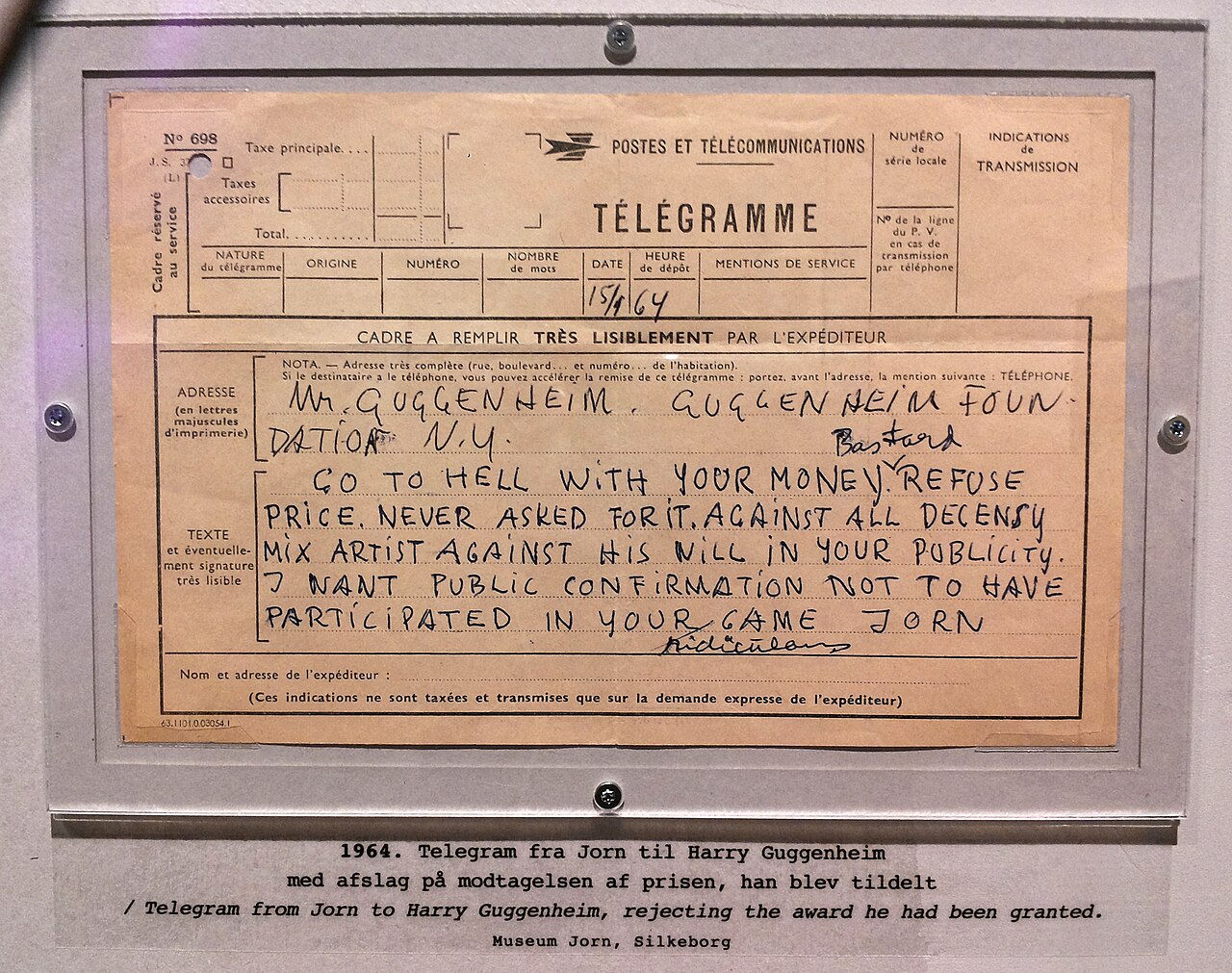
A 1964 handwritten telegram form headed TÉLÉGRAMME, addressed to Mr Guggenheim, reading: GO TO HELL WITH YOUR MONEY. REFUSE PRICE. NEVER ASKED FOR IT. AGAINST ALL DECENCY MIX ARTIST AGAINST HIS WILL IN YOUR PUBLICITY. I WANT PUBLIC CONFIRMATION NOT TO HAVE PARTICIPATED IN YOUR GAME. Signed JORN.
Asger Jorn’s 1964 telegram rejecting the Guggenheim Prize. Museum Jorn, Silkeborg. Photograph by Kasperhj, via Wikimedia Commons. CC BY-SA 4.0  source

“Go to hell with your money.”

REFUSE PRICE. NEVER ASKED FOR IT… I WANT PUBLIC CONFIRMATION NOT TO HAVE PARTICIPATED IN YOUR GAME. — JORN

Thirteen years after CoBrA dissolved, Jorn cabled the Guggenheim Foundation to reject its prize. The gesture is CoBrA’s ethic in one telegram: refuse the institution, refuse the market’s valuation of the act, keep the work outside “the game.” It is the same impulse that made the group disband at its height rather than calcify — and the same current that carried Jorn straight into the Situationist International.
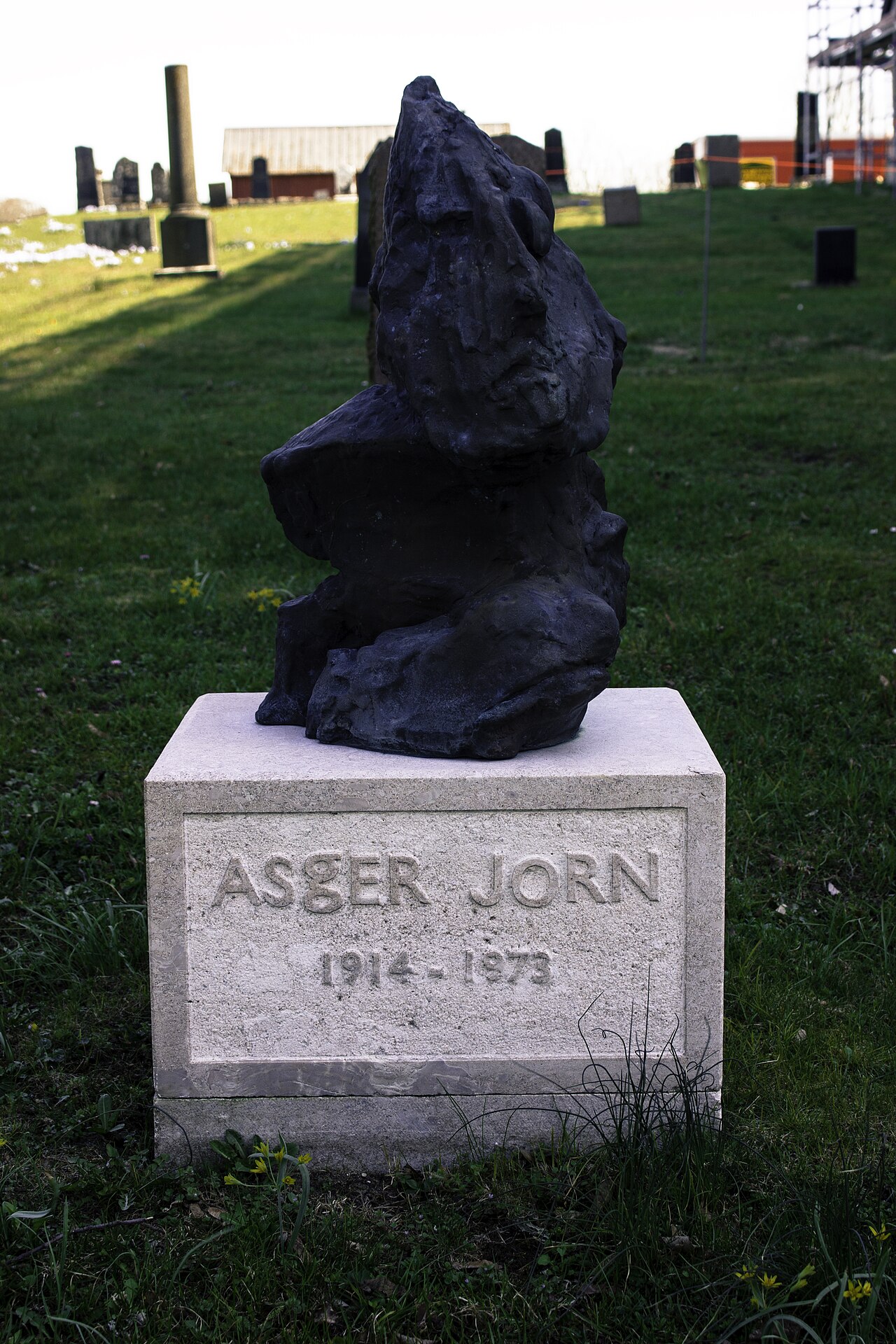
A rough, biomorphic black bronze sculpture — a crude beast-like mass — mounted on a pale stone plinth carved ASGER JORN 1914–1973, standing in a green churchyard.
Asger Jorn’s grave, Grötlingbo churchyard, Gotland, Sweden — a rough black-bronze beast on a bare plinth. Photograph by Bene Riobó, via Wikimedia Commons. CC BY-SA 4.0  source

The fantastic beast, cast in bronze.

Even Jorn’s headstone is a CoBrA creature: unpolished, half-animal, half-mask — spontaneity frozen into metal. The movement’s whole formal vocabulary is here — the mythic beast, the crude hand, colour’s absence answered by pure clotted form — set over a churchyard rather than a gallery. From the harvest circle of Copenhagen to a Gotland grave, the line runs unbroken.
The dossier

Motifs, forces, engines.

01 Motifs

  • spontaneous, childlike, and “primitive” expression
  • the fantastic beast and mask
  • collective, improvised painting
  • art against rationalist abstraction

02 Memetic forces

  • postwar exhaustion made raw, instinctive spontaneity feel like liberation and truth
  • a Marxist-experimental fusion gave the play political weight
  • the international, anti-national comradeship (Copenhagen–Brussels–Amsterdam) was itself the point

Unifying principle

True creativity flows from spontaneous, collective, uninhibited expression — the child, the folk, the mad — against the cold rationalism of geometric abstraction and academic art.

Convergent engines

  • the name binding three cities into one group
  • the collective journal and shared exhibitions
  • joint, improvised painting sessions

× Divergent engines

  • only three years before internal and health crises
  • the pull between painting and political theory
  • members (Jorn, Constant) departing toward the Situationist orbit

03 Internal dynamics

A short-lived, deliberately international avant-garde working collectively and spontaneously across three countries, quick to fracture along artistic and political lines.

04 Society impact

Renewed expressive, gestural painting in postwar Europe and, via Jorn and Constant, fed directly into the Situationist International and New Babylon.

05 Scenius signature

  • Cross-national comradeship and collective spontaneity turning three cities into one experimental body.

Fate — 1951

Dissolved in 1951; its energy flowing into individual careers and, crucially, into Situationist theory and urbanism.


The body

Hands, mediums, masks.

Figures

Asger Jorn Karel Appel Constant Christian Dotremont

Mediums

painting the collective journal collaborative work

Archetypes

Orpheus The Cell / Vanguard

Détournement — the word in the wild

Three cobras that are not CoBrA.

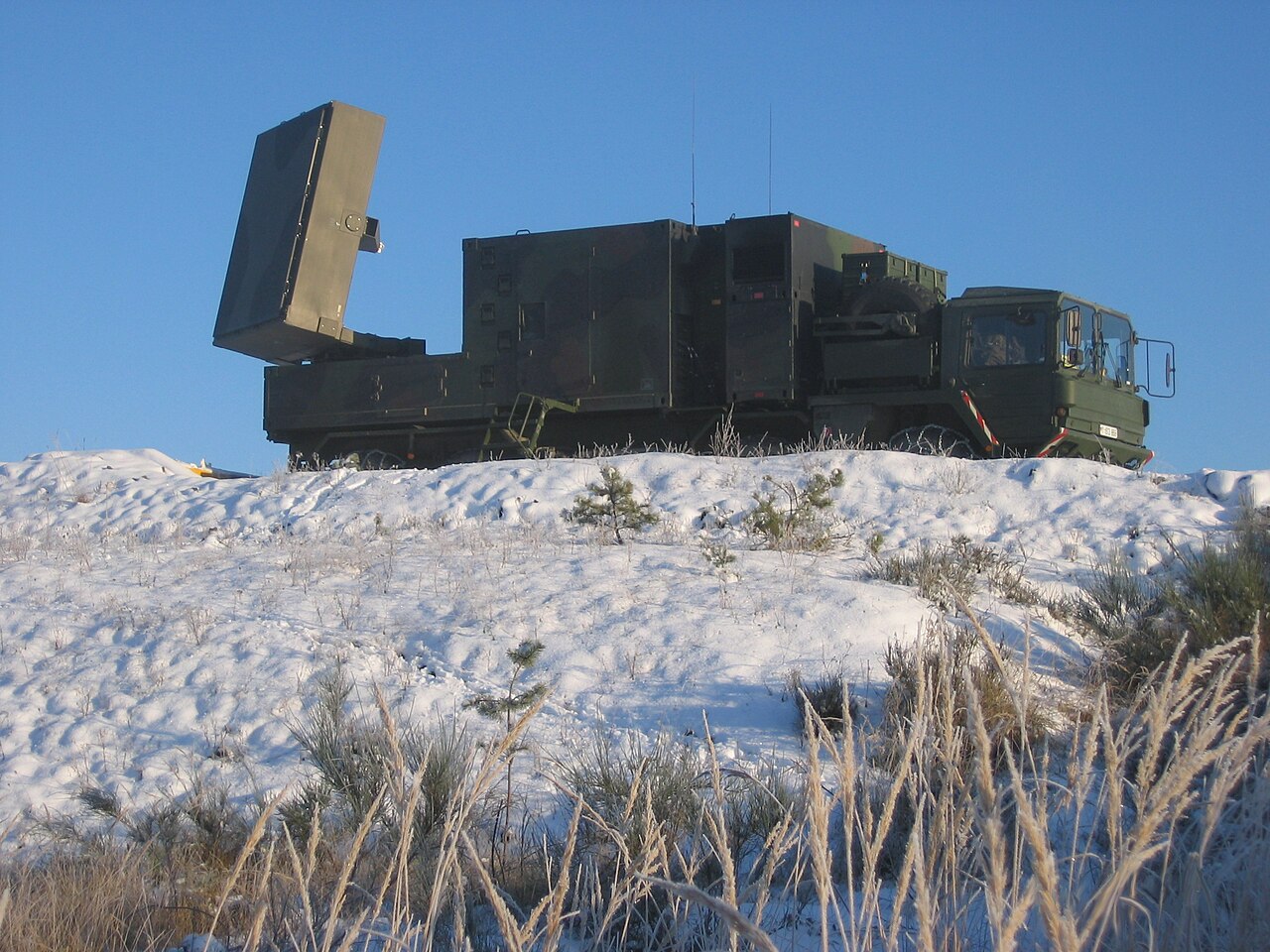
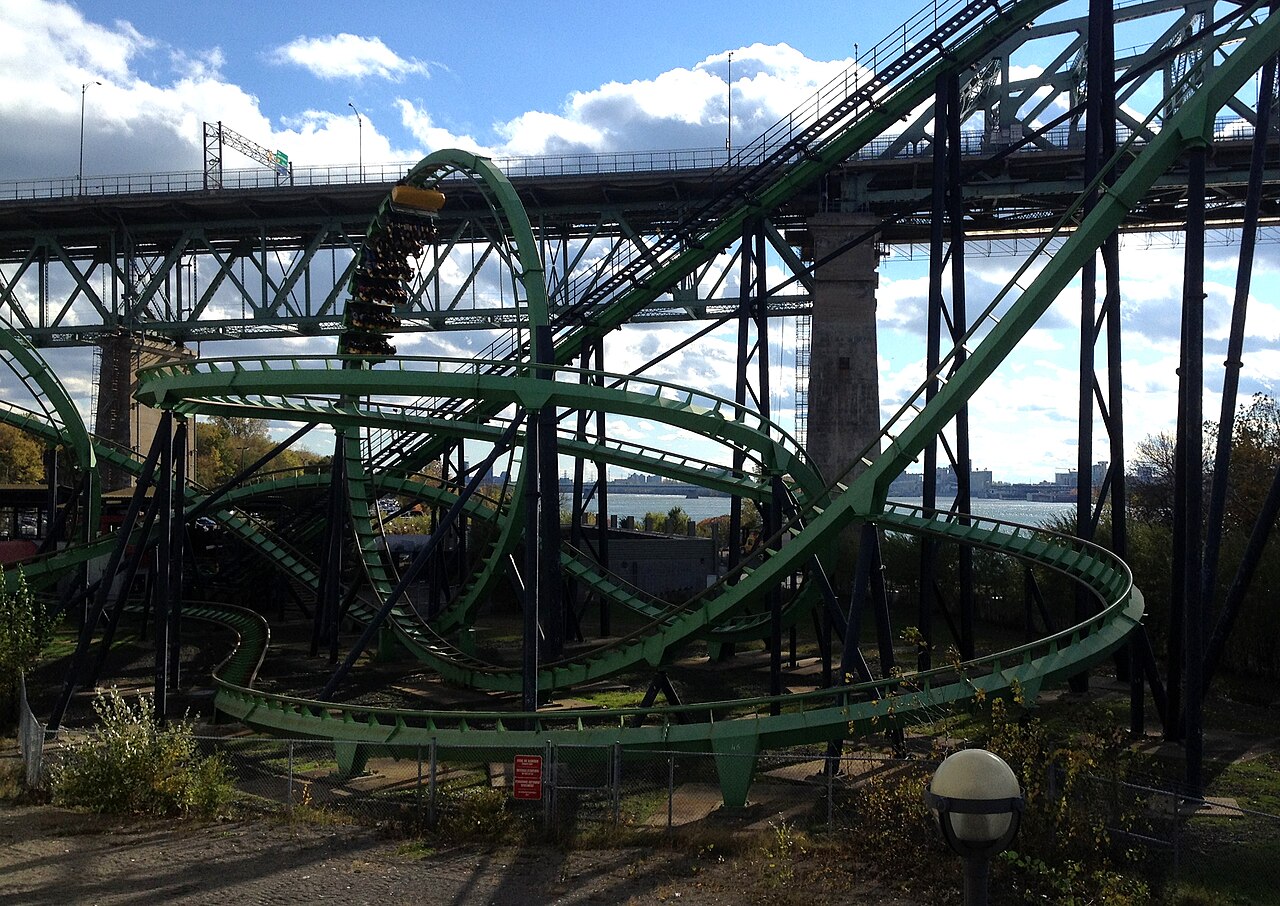
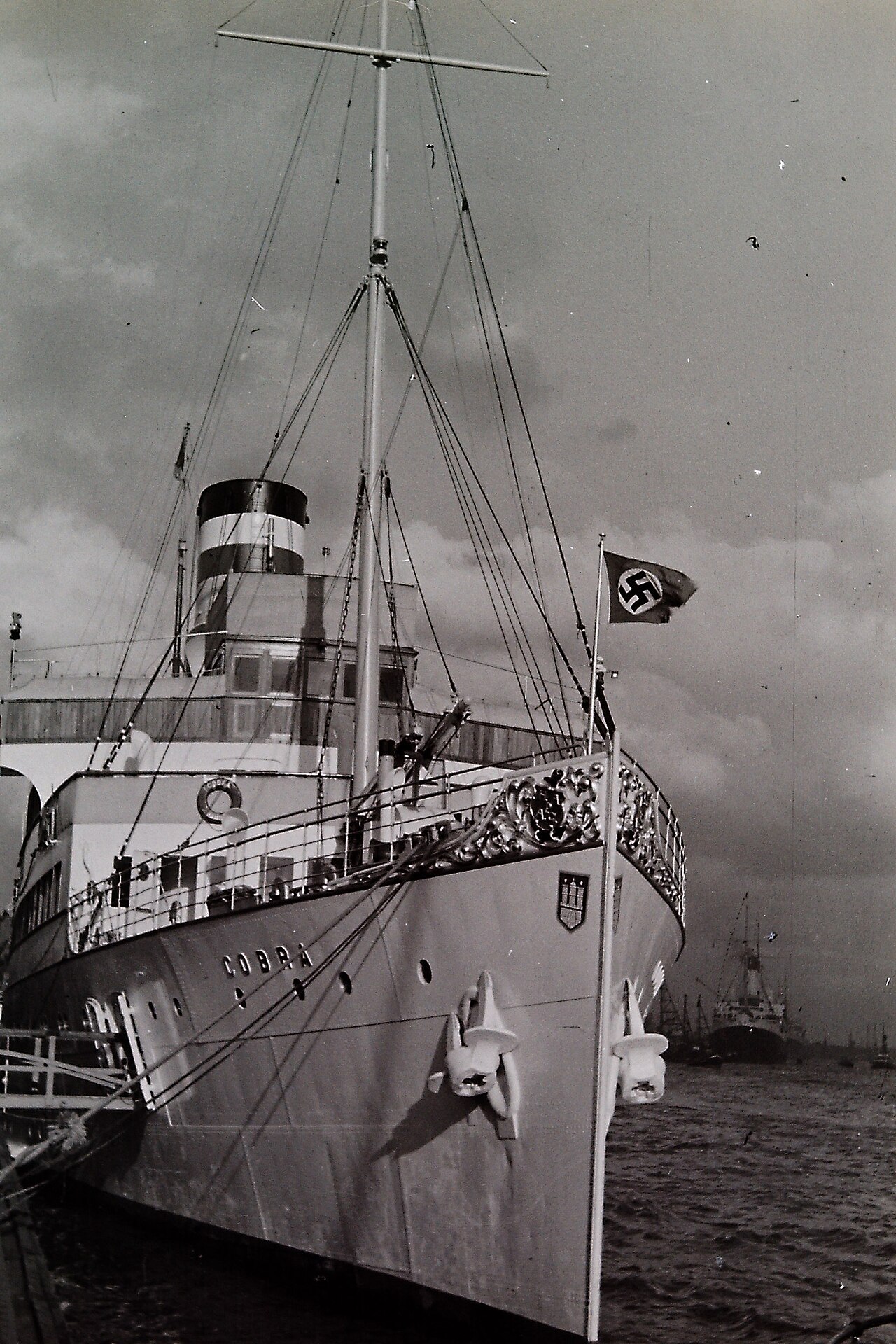
Jorn taught the coming Situationists to détourn — to hijack found images and turn them against their makers. So, in that spirit: these three photographs share only the name. A radar, a fairground ride, a doomed ship — no relation to the painters — repurposed here as an honest joke on the search engine, each fully and truthfully credited. The movement’s beast was never a machine.

A large green-camouflaged military artillery-locating radar unit on a trailer, labelled COBRA.
Namesake · not CoBrA
German artillery-locating radar “COBRA.” Photograph by Radar4587. CC BY-SA 2.0 DE source
A looping steel roller-coaster named Le Cobra against a bright sky at an amusement park.
Namesake · not CoBrA
“Le Cobra” roller-coaster, La Ronde, Montréal. Photograph by Christophe95. CC BY-SA 3.0 source
A black-and-white 1933 photograph of a small excursion steamship named Cobra at a quay.
Namesake · not CoBrA
The HAPAG seaside-excursion ship Cobra, 1933 (lost as a naval mine-ship, 1942). Photograph by Borcholt (after Lothar Hallecker). CC BY-SA 4.0 source
← back to the scenic garden