The Brief
terms of referenceArtist Placement Group was not a style, a school, or a manifesto-bound movement but an institutional device: a small London office through which artists were inserted, on negotiated ‘Open Briefs,’ into the interior of British industry and government.
Founded in 1966 by Barbara Steveni with her husband John Latham, APG’s operating fiction was that the artist could function as an ‘Incidental Person’ — present in a steelworks, an oil company, an airline, or a government ministry not to decorate or illustrate but to observe, question, and potentially redirect the host organization’s own processes, with no obligation to produce a discrete artwork.
The often-repeated slogan, ‘context is half the work,’ names the group’s central wager: that the site of embedding — British Steel, Esso, British European Airways, the Scottish Office — was itself raw material, and that removing the artist from the gallery ‘ghetto’ was as consequential an artistic act as anything made within it.
Instruments of the Office
mediums & methodThe group’s materials were not paint and bronze but the apparatus of the organisation it entered. Its three working instruments:
- The placement / residency — the artist embedded, by negotiation, inside a real firm or ministry.
- The report — the document as artwork; the record of an intervention that need leave no object behind.
- The incidental person — the artist reframed as an agent free of a fixed brief, whose value is presence, attention, and redirection.
The Open Brief: the artist enters with no obligation to produce a discrete artwork. The organisation’s own processes — its context — become the raw material. Removal from the gallery is itself the act.
Archetype on file: The Laboratory.
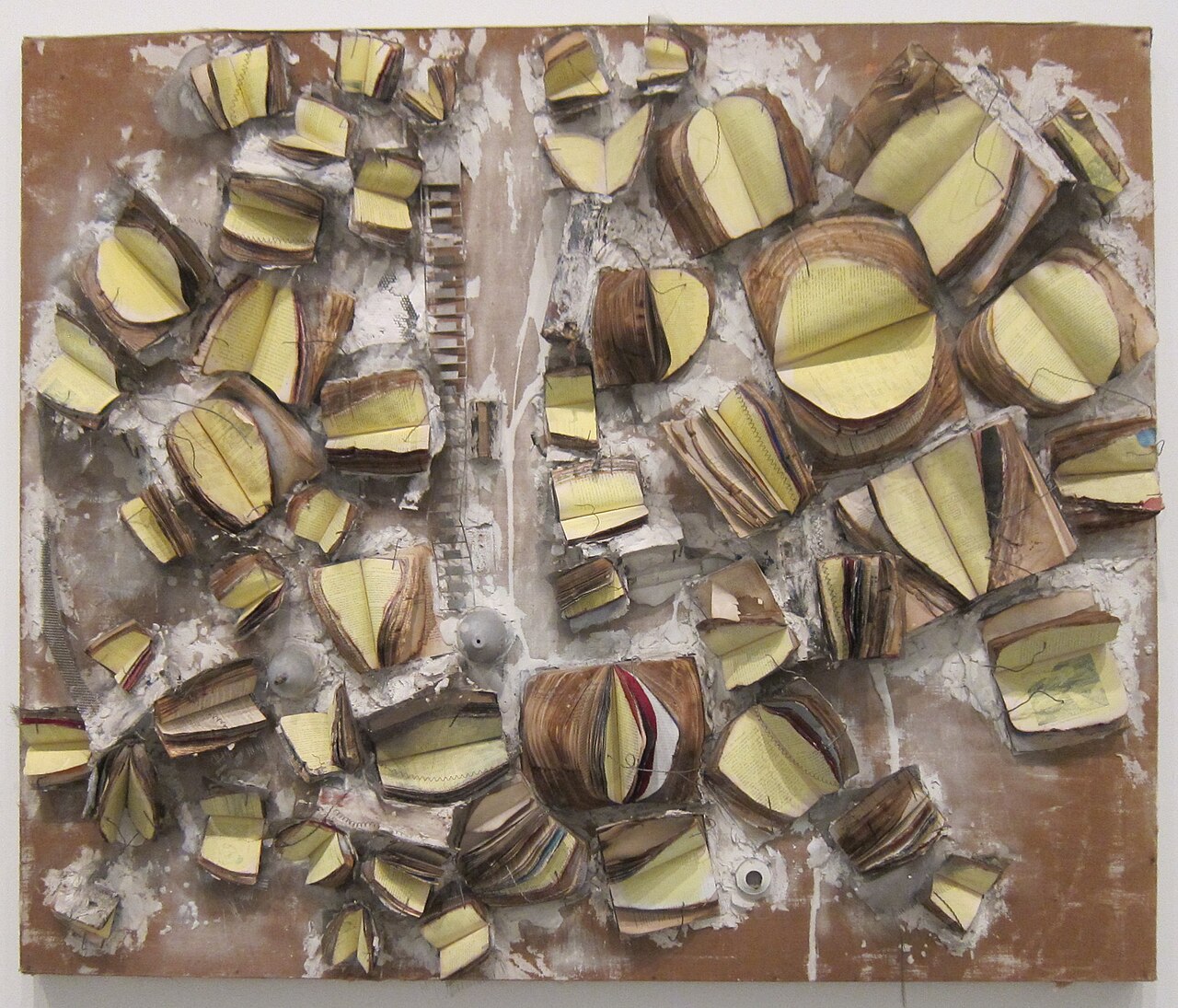
Exhibit: The Book-Relief
j. latham, before APGAttachment A · work by the co-founder

Recurring Motifs
on the file- Placing artists inside organizations and government.
- ‘The context is half the work.’
- The ‘incidental person’ as agent of change.
- Art as social and institutional intervention.
Memetic Forces
why it spread- The radical claim that an artist’s real medium could be an institution, not an object, reframed what art could be.
- Working inside power gave socially-minded artists genuine leverage.
- Latham and Steveni’s conceptual conviction gave the project intellectual weight.
An artist placed inside a company or government — as an ‘incidental person’ with no fixed brief — can make the organizational context itself the artwork, generating social value beyond objects.
Engines — Convergent & Divergent
forces on the balance sheetConvergent — what held it together
- Latham and Steveni’s founding vision.
- Negotiated placements with real institutions.
- A shared conceptual, context-first theory.
Divergent — what pulled it apart
- Dependence on institutions willing to host artists.
- The difficulty of evidencing intangible outcomes.
- Its ideas outrunning what patrons would fund.
Internal Dynamics & Personnel
the office itselfA small, conceptually rigorous organization negotiating artist placements inside firms and government, driven by Latham and Steveni’s theory of context.
Conceived the group and did the ground-level work of securing placements inside industry and government. Her authorship was long obscured by the historical record — the office’s indispensable operator.
Supplied the theoretical vocabulary — the ‘least event,’ time-base, the book as raw matter — that let a placement be read as a work in its own right.
Impact on Society
assessmentA pioneer of socially engaged and institution-based art, prefiguring the artist residency in non-art settings and the whole field of social practice and art-in-context.
Signature & Disposition
closing noteScenius signature
A tiny group insisting the institution itself could be the medium — inventing the artist-in-organization decades early.
Fate of the file
Evolved into O+I and faded, but its ‘context is half the work’ became foundational to socially engaged art.
Appendix: Materials Filed Under “APG”
incidental · mis-filedArchivist’s note. An automated image search returned the following items under the signifier “APG” / “John Latham.” None in fact depict the Artist Placement Group; each is retained here, honestly captioned, as an incidental artefact of the search — a small demonstration of the group’s own thesis, that context is half the work and that the file is never neutral. Full attribution given for each Creative-Commons / public-domain image.



.jpg)
.jpg)