Dornach · 1912 – 1925 · biome: Spirit & Soma
A spiritual science built into a civilization
Steiner's spiritual science, materialized in a whole life-world of schools, farms, medicine, and an organic temple-building.
The building of a world
Anthroposophy was Rudolf Steiner's attempt to build, in a single generation, a complete alternative cosmology and a complete alternative civilization to house it. Steiner — an Austrian editor of Goethe's scientific writings turned clairvoyant philosopher — had risen to General Secretary of the German Section of the Theosophical Society in 1902, but split from it decisively when the Adyar leadership began promoting the young Jiddu Krishnamurti as the vehicle of a coming World-Teacher, a claim Steiner rejected as a betrayal of both Christian esotericism and disciplined inner cognition.
Cornerstone laid on the hill above Dornach — 20 September 1913
Expelled in March 1913, he had already founded the Anthroposophical Society in Cologne (28 December 1912, roughly 3,000 members at the outset) and moved its center of gravity to a hill above the village of Dornach, near Basel, where an international, largely volunteer workforce began carving and raising the double-domed timber Goetheanum as the built form of Steiner's teaching.
The scene fused a claimed rigorous spiritual science of supersensible cognition with an equally serious art program: eurythmy (a new expressive movement art developed with Marie von Sivers), speech formation, four Mystery Dramas, and an architecture and sculpture wholly designed by Steiner himself, down to the carved wooden capitals and painted cupola depicting human evolution.
Burned by arson, New Year's Eve 1922/23 — rebuilt in raw concrete
When the First Goetheanum burned in an act of arson on New Year's Eve 1922/23, the movement's response — an even more ambitious Second Goetheanum in raw expressionist cast concrete, completed in 1928 after Steiner's death in 1925 — testified to the doctrine's capacity to survive catastrophic loss and convert it into renewed total-work ambition.
The single source
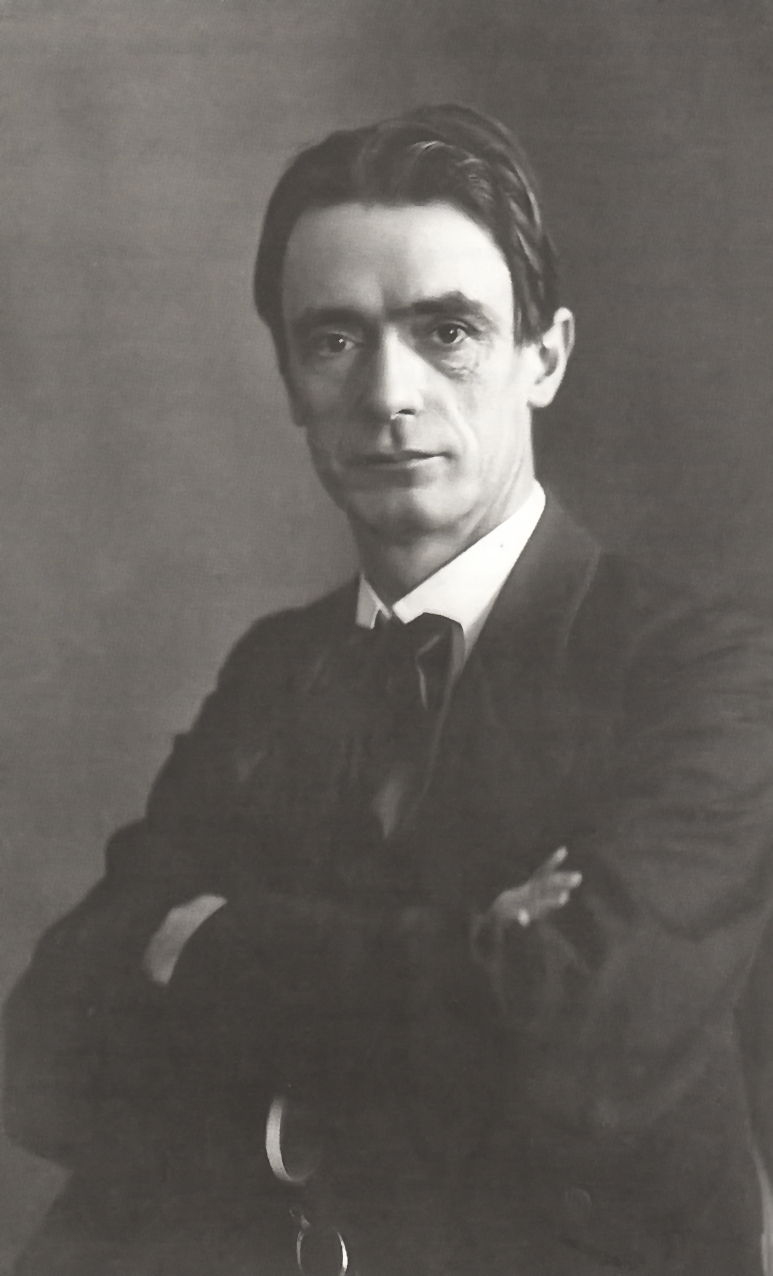
The movement organized itself around one voice. Steiner's vast lecture cycles functioned as its scripture — thousands of talks transcribed into the corpus that members read and re-read — while the Goetheanum stood as headquarters and symbol. Everything radiated from him: the color of the cupola, the shape of a capital, the gesture of a eurythmist, the tuning of a curriculum.
It was the movement's greatest strength and its structural fault. Near-total dependence on Steiner's authority made his death in 1925 an existential rupture — one the doctrine survived only because it had already crystallized into institutions that could carry it without him.
Recurring forms
In the First Goetheanum, each carved column-capital was a metamorphosis of the one before it — Goethe's living form made architecture. These are the movement's recurring themes, read the same way.
Spiritual science — disciplined inner research, held to the rigor of natural science.
The human being suspended between cosmos and earth — the axis of the whole cosmology.
Practical applications — Waldorf schooling, biodynamic farming, anthroposophic medicine.
The Goetheanum as built spiritual form — doctrine carved, cast, and raised into a temple.
Spiritual reality can be investigated with the same rigor as the natural world — and from that science flow renewed ways to reunite humanity with the cosmos.
The forces of a scene
Why it spread
Steiner offered a systematic, "scientific" path to spiritual knowledge that appealed to educated seekers wary of blind faith. The movement's practical outputs — schools, farms, remedies — gave abstract doctrine tangible, self-sustaining institutions. And a total life-world let adherents live entirely within the worldview.
A movement organized around Steiner's teaching and the Goetheanum, sustained after his death by a web of practical institutions more robust than its central doctrine. The periphery — the classrooms, the fields, the clinics — proved sturdier than the esoteric core it was meant to serve.
Made of
Archetypal layers
Steiner edited Goethe's scientific writings before he built anything; colour, after Goethe, he treated as a living deed between light and darkness — the basis of the lazure wall-painting and the painted cupola. The movement's deep pattern joins three archetypes: the remaking of the human being, the total artwork that dissolves art into life, and the pastoral return to a cosmos-attuned earth.
The mark it left
It created Waldorf education and biodynamic agriculture — both now global — plus anthroposophic medicine and organic-architecture currents. The scenius signature: a spiritual doctrine that materialized into a durable life-world of schools, farms, and buildings — ideas made self-sustaining through practice.
Its fate
It lives through its practical institutions — Waldorf, biodynamics — far more than through its esoteric core, which persists quietly around the Goetheanum in Dornach.