← the scenic garden Ant Farm · 1968–1978 · San Francisco / Texas biome: city & structure
An art agency · Chip Lord · Doug Michels · Curtis Schreier File 0/ inflatable · video · monument-prank · performance

Ant
Farm

Media-architecture pranksters whose inflatables, Cadillac Ranch, and televised car-crash turned architecture into counterculture broadcast.

“An art agency that promotes ideas that have no commercial potential.”

Aim: “to be an architecture group more like a rock band.”

TAPE ALL SEAMS 4 MIL POLYETHYLENE WINDOW FAN →

Plate 1 — the cheapest architecture in America: a fan, a roll of plastic, a roll of tape.

01 / dossier

Nomads with a fan

Ant Farm (1968–1978, San Francisco) was a nomadic architecture-art-media collective — Chip Lord and Doug Michels, soon joined by Curtis Schreier, and frequently by Hudson Marquez and Doug Hall — that refused the choice between building and broadcasting. Calling itself “an art agency that promotes ideas that have no commercial potential” and aiming “to be an architecture group more like a rock band,” it converted the freeway, the television, and the vinyl inflatable dome into a decade-long practice of guerrilla video, portable architecture, and desert-scale earthworks, culminating in Cadillac Ranch (1974) and Media Burn (1975) before a 1978 studio fire ended the group's active life.

Architecture should abandon permanence for media, performance, and prank — using inflatables, video, and spectacle to critique the car-and-television culture of consumer America.

Core crew

Chip LordDoug MichelsCurtis Schreier

Mediums worked in

the inflatable video the monument-prank performance

Archetypal layer

The Trickster The Ideal City
02 / recipes

Standing motifs

  1. Media architecture and the inflatable.
  2. The televised spectacle-prank — Media Burn, Cadillac Ranch.
  3. Architecture dissolved into performance and video.
  4. Countercultural critique of car-and-TV America.

Why it spread

1

Memetic force

Fusing architecture, radical politics, and media spectacle was novel, funny, and irresistibly quotable.

2

Memetic force

The inflatable and the prank were cheap, mobile, and participatory.

3

Memetic force

Early adoption of portable video gave them a new medium to own.
03 / earthwork

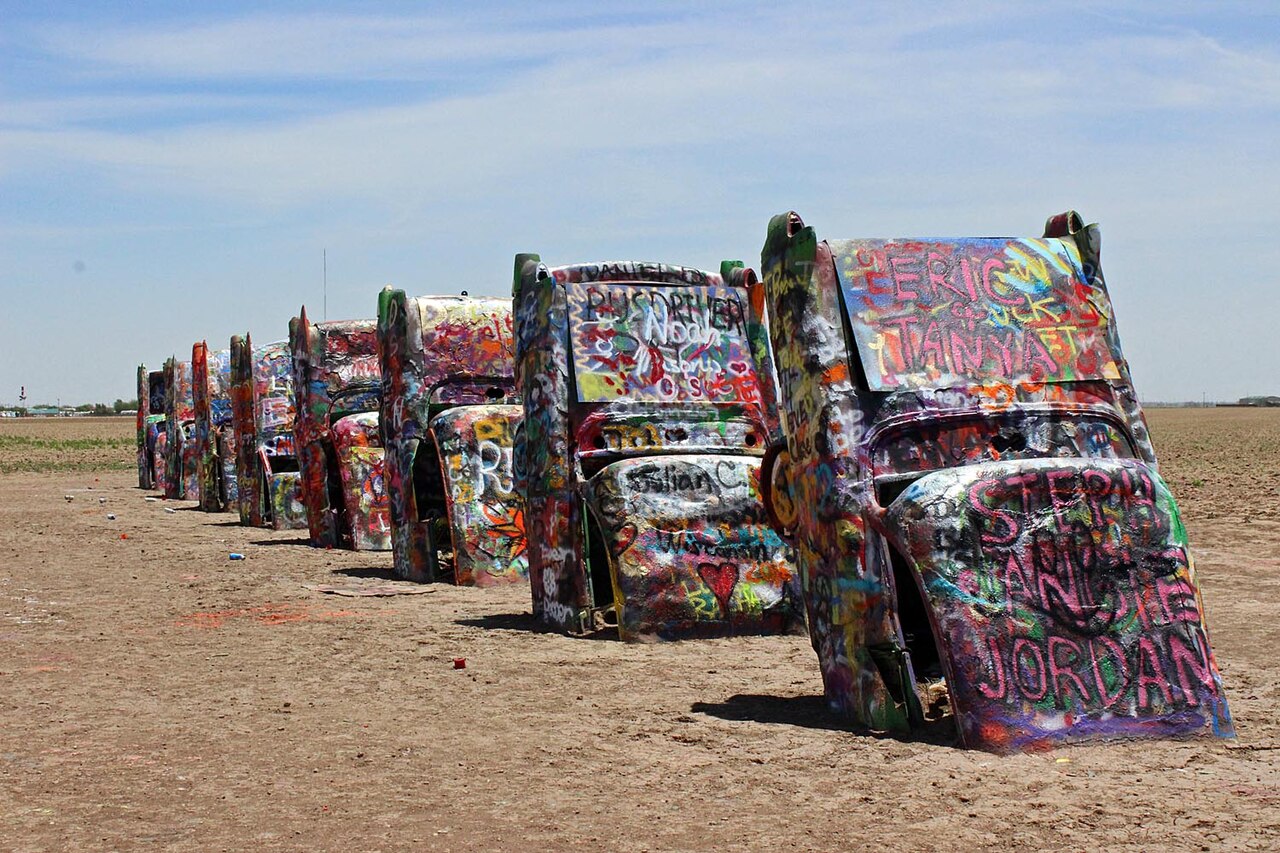
Cadillac Ranch, 1974

Ten tailfins planted nose-down in a Texas wheat field beside Route 66 — a monument built out of the exact object it indicts. Made by Chip Lord, Hudson Marquez and Doug Michels: the automobile as obelisk, the highway as gallery, the prank as permanent public art.

TEN CARS · ONE ANGLE · WHEAT FIELD · U.S. 66 · AMARILLO, TEXAS
Row of Cadillacs buried nose-first at an angle in a Texas field, their tailfins in the air and their bodies covered in layers of spray-paint graffiti, under a wide sky.
Cadillac Ranch, Amarillo, Texas — created in 1974 by Chip Lord, Hudson Marquez and Doug Michels of Ant Farm. Visitors have repainted it continuously ever since; the monument is finished by the public that comes to deface it. Photograph by scott1346 from Mechanicsville, MD, USA · licensed CC BY 2.0 · source on Wikimedia Commons
04 / broadcast

Media Burn, 1975

A customised car driven through a wall of burning television sets, staged for the cameras that came to film it: the prank engineered so that the coverage is the work. Ant Farm picked up the portable video Portapak early and made the news event itself their building material — the Media Van, The Eternal Frame, the press conference as architecture.

Architecture reborn as countercultural media.

Internal dynamics

A small collaborative practice making inflatables, videos, and staged spectacles rather than buildings, embedded in 1970s counterculture.

Society impact

A pioneer of media architecture, video art, and the architectural prank; its Cadillac Ranch and Media Burn became icons and it prefigured critical and speculative design.

Scenius signature

A collective that swapped buildings for inflatables, video, and prank — architecture reborn as countercultural media.

05 / pressure

Inflate / deflate

Every inflatable is a balance of the fan pushing in and the seams letting go. So was the group.

↑ Convergent — the fan

  • A tight collective (Lord, Michels, Schreier).
  • The shared media of inflatables, video, and staged events.
  • The West Coast counterculture context.

↓ Divergent — the leak

  • A studio fire and the group's dissolution in 1978.
  • The ephemerality of media-and-performance work.
  • Members' move into film, teaching, and design.
06 / fate

The fire, 1978

Disbanded after a 1978 fire; its members dispersed into media and teaching, its works now landmarks of radical architecture and video art. A practice that burned televisions for an audience was ended by a fire in its own studio — the last, unstaged spectacle.

Credits, licences & sources

Image used under its stated licence; all rights with the photographer.

Coded from public web sources (Wikipedia-led); not yet independently verified. Confidence: high.

← the scenic garden